<?xml version="1.0" encoding="utf-8"?><feed xmlns="http://www.w3.org/2005/Atom" ><generator uri="https://jekyllrb.com/" version="3.10.0">Jekyll</generator><link href="/feed.xml" rel="self" type="application/atom+xml" /><link href="/" rel="alternate" type="text/html" /><updated>2026-09-13T02:06:48+00:00</updated><id>/feed.xml</id><title type="html">清风米店</title><subtitle>欢迎光临清风米店！清风取自“清风掠旷野，平地起波澜”，米店是我最喜欢的一首歌。</subtitle><entry><title type="html">如何培养长期的习惯</title><link href="/100%E7%AF%87%E6%95%99%E7%A8%8B/2026/07/19/long-term-habit.html" rel="alternate" type="text/html" title="如何培养长期的习惯" /><published>2026-07-19T03:05:53+00:00</published><updated>2026-07-19T03:05:53+00:00</updated><id>/100%E7%AF%87%E6%95%99%E7%A8%8B/2026/07/19/long-term-habit</id><content type="html" xml:base="/100%E7%AF%87%E6%95%99%E7%A8%8B/2026/07/19/long-term-habit.html"><![CDATA[<h1 id="如何培养长期的习惯">如何培养长期的习惯</h1>

<p>很早之前读到过一个故事，发生在古希腊的苏格拉底和他的学生之间。</p>

<p>苏格拉底让自己的学生每天甩手300下，大家都认为这个事情很简单。但过了一年之后，苏格拉底再问学生，有谁还在做这件事情的，只有一个人举手，此人是柏拉图。</p>

<p>这个故事应该是不实的，是后人为了某种教育目的，为了传递某种观念杜撰的。它可以有以下几种解释：</p>

<ol>
  <li>怪不得柏拉图能够成为苏格拉底之后继承古希腊哲学的大家，人家有恒心、有毅力，能够坚持常人所不能的事情。</li>
  <li>看似简单的事情，如果加上长期的要求，也就变得很不容易了（所以，更不必说那些复杂的事情了）。</li>
  <li>每天甩手300下，做这件事情的动机、目的、意义何在？如果是为了培养长期的习惯，为什么不能做点别的呢？把宝贵的时间浪费在这种无聊的事情上，越是长期，则越是谬误。</li>
</ol>

<p>这里借用这个虚构的故事，是想用到后面两条结论：</p>

<blockquote>
  <p>简单<sup id="fnref:1" role="doc-noteref"><a href="#fn:1" class="footnote" rel="footnote">1</a></sup>的事情，才可以长期地做下去。</p>

  <p>值得长期做的事情，才值得培养为习惯。</p>
</blockquote>

<p>两条标准缺一不可。一件事儿再简单，如果只是无聊地打发时间，长期做下去也没有意义；一件事再有价值，如果步骤复杂、门槛太高，也很难持续。长期习惯的理想状态，是这两条标准的交集。</p>

<p>首先，这不应该是一个需要坚持的习惯，想办法把它变得和吃饭喝水一样自然。求生的本能保证了这两件事是不需要坚持的。如果一件事情竟然是需要坚持的，那它注定做不长久，因为坚持就意味着抗拒，因为坚持就意味着抗拒，这样放眼长期，抗拒的力量会越来越强，直到这个习惯被遗忘。</p>

<p>其次，既然是需要长期做的事情，就需要倾注时间和生命。谁会愿意把自己的时间浪费到毫无疑义的事情上？选择的一个参考标准是，能否产生复利效应，提高生活质量、提升生活的幸福感。</p>

<p>想来到现在为止，我培养成的长期的习惯有两个：读书和健身。</p>

<p>上学做兼职打工挣钱之后，给自己买了个kindle，到现在都快用了十年了。之后发现了更好用的微信读书。</p>

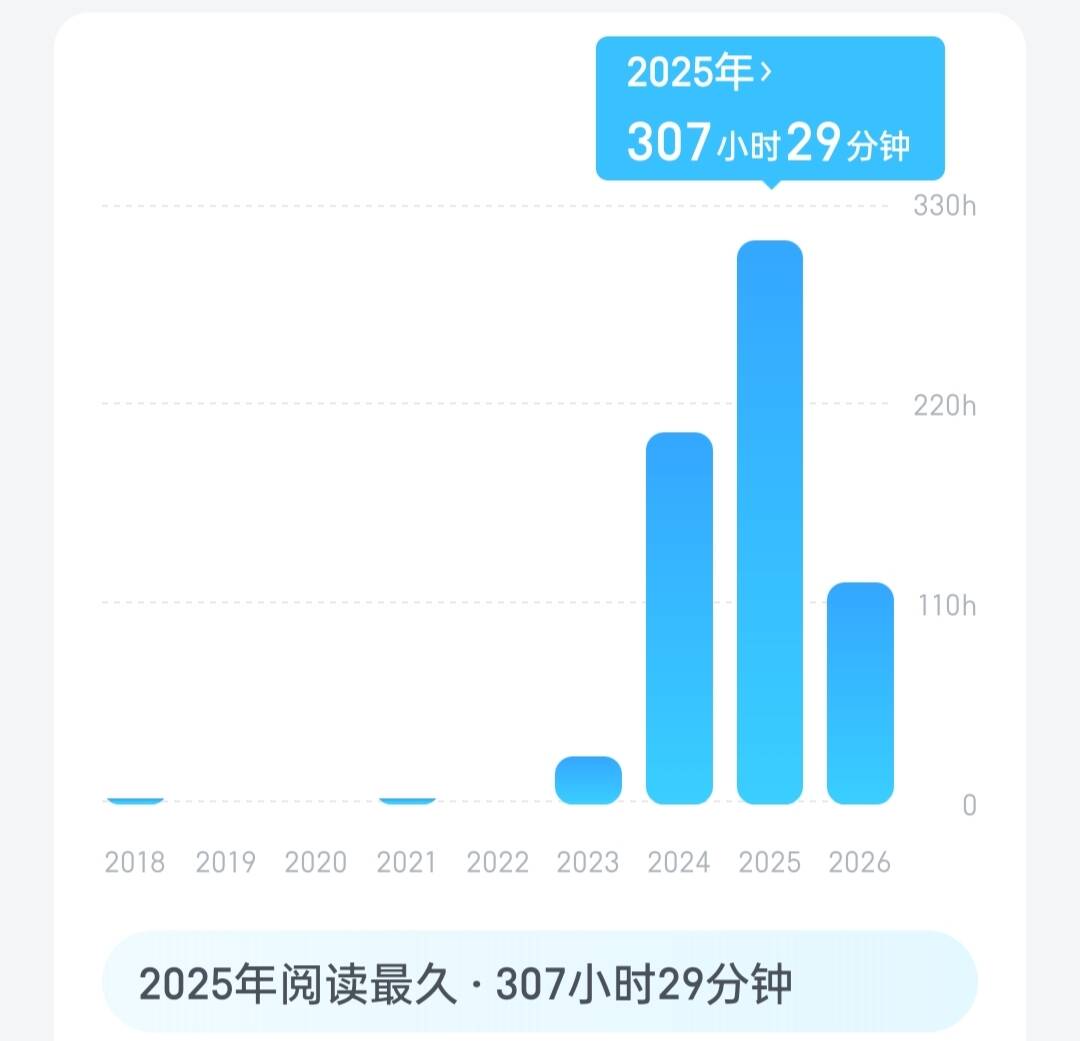
<p>微信读书有一个打卡活动：每天阅读，累计满一年、超过300小时，可以兑换一年会员。我参加过一次，确实读了很多，一年读了17本。但活动结束后，就没有再参加。不是因为不想读了，而是意识到：长期习惯不意味着每天都要做。”每天必须读”更像是一个外部约束，它会把人绑在打卡日历上，忙的时候徒增焦虑，闲的时候又为了完成指标而硬读。久而久之，阅读的愉悦会被抵触感稀释。</p>

<p>今年不再参加活动，反而读得更自由。忙的时候可以不读，有空的时候读几篇博客或长文也算。阅读的范围也不限于微信读书，高质量的博客、论文都是优质的输入来源。长期来看，读了1000本书还是1200本书，并没有本质区别，因为都读了很多很多。</p>

<p><img src="/assets/images/2026-07-19/77abecbe80c91893fa1989bb85f84f62_720.jpg" alt="77abecbe80c91893fa1989bb85f84f62_720" /></p>

<p>这就要说到第三点，对于这种长期的习惯，不要给它设置过于详细具体的目标和里程碑。随性一点，如果一段时间有点忙，放放也不是不可以，后面记得捡回来就行。比如<strong>我一个月要看完一本书</strong>这种，实在没有必要。有些轻松的小说故事，不到一周就可以读完，有些严肃难读的大部头，一年都不一定读得完。</p>

<p>这里区分一下两种目标：</p>

<ul>
  <li><strong>僵化指标</strong>：每月一本书、每周三次、每天30分钟。这类目标容易把习惯变成任务，一旦中断就产生挫败感。</li>
  <li><strong>方向性系统</strong>：保持阅读、保持运动、持续输入。它只规定一个方向，不规定具体频率和产出。</li>
</ul>

<p>长期习惯更需要的是后者。它不是项目，而是生活结构的一部分。</p>

<p>再说健身，到现在差不多有4年了。最初是跟着一个同学在学校的健身房练，后来上班后就在公司的健身房练。起初的时候一周三次，后来各种事情多起来之后一周一次两次，也不给自己设置什么其他要求，有空了去一趟，不受伤就行。就这样不知不觉过了这么久。</p>

<p>之所以能成为习惯，不只是因为步骤简单，更因为它带来了真实的复利效果：精力更好、身体状态更可控、工作一天后的疲惫感也减轻了。这些正反馈让人更愿意继续，而不是靠坚持的念头在逼自己。</p>

<p>总结一下，想要培养长期的习惯可以从这三点开始：</p>

<ol>
  <li>选择步骤简单的事情，降低启动成本。</li>
  <li>想清楚这是否是值得长期做的事情。</li>
  <li>一开始不要设置过于详细具体的目标，允许中断，允许弹性。</li>
</ol>

<div class="footnotes" role="doc-endnotes">
  <ol>
    <li id="fn:1" role="doc-endnote">
      <p>这里的简单是指这件事的步骤不复杂，而不是事情本身简单，比如读狭义相对论的论文就是个比较简单的事情，因为只需要读和想就行了。与之相对的复杂的事情是指那些步骤繁多的事情，比如大公司内部做事时从审批到执行的复杂流程。有谁会喜欢搞这种步骤繁多手续复杂的事情，并把它当成习惯呢。 <a href="#fnref:1" class="reversefootnote" role="doc-backlink">&#8617;</a></p>
    </li>
  </ol>
</div>]]></content><author><name></name></author><category term="100篇教程" /><summary type="html"><![CDATA[如何培养长期的习惯]]></summary></entry><entry><title type="html">“真理多走一步，就会变成谬误”的例子</title><link href="/100%E7%AF%87%E6%95%99%E7%A8%8B/2026/04/11/oversimplification-over-generalization.html" rel="alternate" type="text/html" title="“真理多走一步，就会变成谬误”的例子" /><published>2026-04-11T04:05:53+00:00</published><updated>2026-04-11T04:05:53+00:00</updated><id>/100%E7%AF%87%E6%95%99%E7%A8%8B/2026/04/11/oversimplification-over-generalization</id><content type="html" xml:base="/100%E7%AF%87%E6%95%99%E7%A8%8B/2026/04/11/oversimplification-over-generalization.html"><![CDATA[<h1 id="真理多走一步就会变成谬误的例子">“真理多走一步，就会变成谬误”的例子</h1>

<blockquote>
  <p>真理多走一步，就会变成谬误。</p>

  <p>—— 列宁</p>
</blockquote>

<p>小时候学校的墙上挂了很多名人名言，其中上面这句记了很久，因为那时一直不理解，在什么情况下，真理多走一步之后会变成谬误。最近读《beyond feelings》，才终于找到了这种真理多走一步之后变成谬误的例子。</p>

<p>顺便，找到了上面那个引用的最精确的原文和出处：</p>

<blockquote>
  <p>……然而，只要再多走一小步，看来像是朝同一方向多走了一小步，真理就会变成错误。……</p>

  <p>——《共产主义运动中的“左派”幼稚病》</p>
</blockquote>

<p>《beyond feelings》第二章专门介绍认知偏差（cognitive bias），其中以下两种与上面的内容关系比较密切：</p>

<ul>
  <li>Overgeneralization，过度概括。</li>
  <li>Oversimplification，过度简化。</li>
</ul>

<h2 id="过度概括">过度概括</h2>

<p>概况，是从特定个例中提取出通用的规律或结论的思维活动。类似数学中的归纳法，根据观察到的例子，总结规律。根据见到的个例进行概括不仅是人的一种很自然的能力，也是学习过程中必不可少的一种能力。</p>

<p>达尔文的《物种起源》就是个很恰当且科学的概括。他考察世界上不同地方的生物之后，提出了进化论。显然他无法观察过所有的生物，但这不妨碍他的理论的正确性。</p>

<p>但过度概括，就是在只观察到一小部分个例之后，就基于这些观察总结规律，概括结论，而得出的规律或结论，明显是无法推广到所有（至少是绝大部分）样本的。</p>

<p>例如，有人总是从媒体上听到一些人炒股亏损的信息，就简单地得出结论认为股市都是骗人的，炒股肯定会亏。而事实上，如果策略正确的话，是可以长期盈利的，比如最简单的定投策略。</p>

<p>很多年前放暑假去郑州转车，当时滴滴还没有成长为大平台，都还是传统的打车方式。当时我想打一个出租车去另一个车站，旁边的出租车司机狮子大张口，要了2倍以上的价钱。我要求打表，他直接说，打表就要绕路。这件事让我对郑州的出租车司机印象大减，心里其实在暗骂，郑州的出租车司机都是这个鬼样子。</p>

<p>我们可以从恰当的概括中总结出真理（事实），但如果多走一步，没有观察到足够多的样本，或者下的结论过于绝对，就反而是谬误了。</p>

<p>一般情况下，过度概括不会有什么很严重的后果，例如因为身边某个人的性格怎样，就扩展到对他们所在的地域的人有类似的印象（这种又称为刻板印象）。</p>

<p>但如果涉及到重大决策，比如商业战略选择，就需要谨慎考虑。犯了过度概括的错误，是会损失自己的真金白银的。</p>

<p>避免过度概括，需要从两方面入手。首先，观察要足够全面，尽可能不漏掉任何有代表性的样本；然后，下结论、做决策要谨慎，不过于绝对。</p>

<h2 id="过度简化">过度简化</h2>

<p>简化，是从过于复杂的事物中剔除不重要的部分，抓住最重要部分的能力。人类认识世界就依靠的是恰当的简化的能力。在当前知识高度专业化的背景下，不同领域的人进行交流就需要把自己领域的复杂知识进行恰当简化，然后讲给对方，好让对方在没有专业背景的情况下能够理解。</p>

<p>考试其实也是一种选拔人的简化方案。怎样从一群人中筛选出适合的、能够胜任的人，是人类一直在尝试解决的一个问题。目前来看，考试是一个相对最合适的方案，特别是大学入学和公务员的选拔。</p>

<p>过度简化，是在分析问题时不光丢掉了不重要的部分，把重要的部分也丢掉了。它会导致对问题的理解出现偏差和歪曲。</p>

<p>比如分析学生没有学会某门课的知识时，有些家长认为<strong>就是老师没有教好</strong>，他们的逻辑是这样的：</p>

<blockquote>
  <p>如果老师教得好，我家孩子能学不会吗。</p>
</blockquote>

<p>这些家长过度简化了教学的过程，把它只理解为老师的教授过程，而忽略学生学习的过程。</p>

<p>恰当的简化有助于发现真理，可一旦过于简化，就会得到错误的结论。</p>

<p>避免过度简化，需要分清主次（主要矛盾和次要矛盾）。但是如何才能分得清楚，不是一件容易说清的事情。</p>]]></content><author><name></name></author><category term="100篇教程" /><summary type="html"><![CDATA[“真理多走一步，就会变成谬误”的例子]]></summary></entry><entry><title type="html">租房避坑指南</title><link href="/100%E7%AF%87%E6%95%99%E7%A8%8B/2026/03/13/%E7%A7%9F%E6%88%BF%E9%81%BF%E5%9D%91%E6%8C%87%E5%8D%97.html" rel="alternate" type="text/html" title="租房避坑指南" /><published>2026-03-13T14:05:53+00:00</published><updated>2026-03-13T14:05:53+00:00</updated><id>/100%E7%AF%87%E6%95%99%E7%A8%8B/2026/03/13/%E7%A7%9F%E6%88%BF%E9%81%BF%E5%9D%91%E6%8C%87%E5%8D%97</id><content type="html" xml:base="/100%E7%AF%87%E6%95%99%E7%A8%8B/2026/03/13/%E7%A7%9F%E6%88%BF%E9%81%BF%E5%9D%91%E6%8C%87%E5%8D%97.html"><![CDATA[<h1 id="租房避坑指南">租房避坑指南</h1>

<p>最近换房子，新租了一个开间，整个过程很不顺利。再结合之前租房子时踩过的坑，整理一下，希望对刚开始租房的小伙伴们有帮助。</p>

<p>租房的流程基本上有：看房子、交押金、签合同、入住。</p>

<h2 id="看房子看什么">看房子看什么</h2>

<ol>
  <li>
    <p>卫生间什么情况，马桶冲水好使不好使。这是第一次租房子踩的坑，估计会记一辈子吧，心理阴影超大。</p>
  </li>
  <li>看朝向、采光，一定要有光能照进来。阳光是最好的心理疗愈辅助工具。</li>
  <li>看墙是石墙还是人工隔出来的。墙体的隔音很重要。</li>
  <li>水电价格，商水商电？民水民电？第二次租房的时候租的小公寓是商业电价，不到20平的小屋，一个月用电费150块，还是我只在洗澡的时候开热水器。商电1.5/度，民电不到0.7/度（阶梯电价另算），差了一倍。</li>
  <li>集中供暖还是自采暖。自采暖，如果不是用壁挂炉的话，一个月差不多是400块。同样是第二次租的小公寓，取暖费收了1500，但是还很冷，冷到窗户结冰，把我的袜子都冻硬了。</li>
  <li>可以接什么网络。目前了解到的，联通网络比较坑，一办就是三年起，毁约的话得赔20个月的费用（？），而且刚办的时候都不会跟我们说这些，等到想退了他们才说，而且手续贼麻烦。</li>
</ol>

<h2 id="关于押金">关于押金</h2>

<blockquote>
  <p>一定要等到房间满足你的要求之后再交押金，不要被中介催几次就早早交了。押金在自己手里，当对方做得让你不满意，就可以随时走，不至于被拿捏。</p>
</blockquote>

<p>首先是看房子和交押金。这次因为搬家仓促，看着合适就比较早地把押金交了，然后吃了大亏。那间房子一共看了两次，第一次对象帮忙看的，说不错，但是有一些小问题：1）屋子里只有一个柜子，不够放衣服；2）没有床；3）房间没有打扫，有灰尘；4）没有桌子，没有吃饭的地方。所以当时看完之后，就反复跟中介强调，要把房间打扫一下。</p>

<p>3号第一次看完之后，中介就催着交定金（注意这里），他们会反复催你交定金，似乎还是不好意思拒绝别人的心理，所以就交了。但是到8号我第二次去看，房间依然没有打扫，其他东西也没有配齐（这倒是其次）。然后8号准备签合同的时候，房东倒是说让我自己找保洁打扫，然后他掏钱。之后又继续给中介说，让他们给打扫，竟然说他们没有保洁，只能介绍人。分明就是推脱！想在想起来都还很气。</p>

<p>现在想想，如果等到房间满足我的要求了再签合同，就不至于这么被动了。</p>

<blockquote>
  <p>再次强调，不要早早把押金交了，否则就使唤不动他们了。</p>
</blockquote>

<h2 id="关于家具">关于家具</h2>

<blockquote>
  <p>如果对家具不满意，就早点说，早点表达，勇敢表达。</p>

  <p>记住，如果你感觉自己被坑了、自己吃了本不必要的亏，一定不是错觉，就是不公平，就是不合理，坚决说不！</p>
</blockquote>

<p>房东说给配家具，之前就说的是给配个双人床，结果给搞了个 1.5 x 1.8 的双人床？开玩笑呢！睡两个小孩还差不多。但是我当时其实是犹豫了一下，等装床的人走了才给房东打电话说不合适，太小了。结果搞得就很不愉快，房东嫌弃运费，装床的人也走了，也不愿意回来拉走。</p>

<p>现在想想，就应该当场看到床太小，当场就给房东打电话说不行，让送货师傅拉回去。</p>

<h2 id="入住之后">入住之后</h2>

<blockquote>
  <p>签合同之前，确认一下房屋的维修是谁负责。这个内容合同上应该会写。</p>
</blockquote>

<p>住进去之后，可能涉及到房屋设施的维修。有些中介公司，每个月收服务费（我租的第三家，每月收房租的5%，后来也涨价了）。这样维修就是他们的事情，当时刚住进去那几个月，几乎每周找维修服务，从马桶到水龙头、花洒、灯泡、空调，都修过换过，这就比较省心，就是贵点。住得越久，服务费抽血越多。还有一种中介公司，只一次性收取一个月的租金。这种的是不管维修的，维修是房东的事情。遇到热心的好房东，倒也很好。上一家的房东就很好，自己掏腰包给我们买了洗衣机用，花洒坏了也很快给我们拿新的花洒用，点赞！。感觉新租的这个房东，就不够实在，配桌子的时候还说多给我们配几个椅子，说是万一朋友来还有地方座，结果真给配的时候，就两个。典型的说得比做得多。</p>

<p>这次的中介，就是第二种中介。签合同之后问她能办什么网，她也不知道。我觉得这些事情，中介是需要了解的，再加上之前房子都不给收拾的事情，就给那个中介一通怼。他们这种赚的算是一锤子买卖，你把钱给人家，人家就不会再管你了。</p>

<p><strong>最后的最后，签合同要慎重，一定要看看都写了啥。签名是要承担责任的。还有，出钱要慎重，不要傻傻地出钱还买不到应得的服务。</strong></p>]]></content><author><name></name></author><category term="100篇教程" /><summary type="html"><![CDATA[租房避坑指南]]></summary></entry><entry><title type="html">自我实现与自我超越</title><link href="/%E9%98%85%E8%AF%BB%E9%9A%8F%E7%AC%94/2026/03/07/search-for-meaning.html" rel="alternate" type="text/html" title="自我实现与自我超越" /><published>2026-03-07T02:05:53+00:00</published><updated>2026-03-07T02:05:53+00:00</updated><id>/%E9%98%85%E8%AF%BB%E9%9A%8F%E7%AC%94/2026/03/07/search-for-meaning</id><content type="html" xml:base="/%E9%98%85%E8%AF%BB%E9%9A%8F%E7%AC%94/2026/03/07/search-for-meaning.html"><![CDATA[<h1 id="自我实现与自我超越">自我实现与自我超越</h1>

<p>这个题目源于《beyond feelings》第一章<strong>who are you</strong>的一道课后题目：</p>

<blockquote>
  <p>Imagine how different America might be if Frankl’s emphasis on self-transcendence and personal responsibility, rather than Maslow’s emphasis on self-actualization and popular culture’s emphasis on self-esteem, had been dominant for the past fifty years. List as many ways as you can in which our society might be different today and comment on whether each would be beneficial or harmful. Be prepared to explain your views in class discussion.</p>

  <p>试想，如果过去50年间是弗兰克的自我超越和个体责任的理论，而不是马斯洛的自我实现和大众文化中对自尊的强调成为主流，美国当今社会会有怎样不同？尽可能多地列举你能想到的，这个社会可能有怎样的不同，并且说明哪些变化是有益的，哪些变化是有害的。准备在课堂讨论中解释你的观点。</p>
</blockquote>

<p>由此分别了解了下自我超越（self-transcendence）和自我实现（self-actualization）这两个概念。</p>

<p>它们根本上都是为了回答一个问题——生命（生活）的意义是什么。</p>

<p>马斯洛（Abraham Maslow）在《人类动机理论（A Theory of Human Motivation）》一文中，定义自我实现如下：</p>

<blockquote>
  <p>It refers to the desire for self-fulfillment, namely, to the tendency for him to become actualized in what he is potentially.</p>

  <p>（自我实现指，它指的是实现自我的愿望，也就是一个人倾向于把自己潜在的可能性转化为现实。）</p>
</blockquote>

<p>换句话说，<strong>人具有一种内在动力，去发展并实现自身的潜能。</strong></p>

<p>马斯洛早期的理论中，把自我实现作为人的最终极的动机，但在后期，他也意识到了问题，也在最初的需求层次中，在自我实现之后加上了自我超越这一动机。</p>

<p>维克多 弗兰克在《追寻生命的意义（man’s search for meaning）》这本书，以及他的意义疗法的文章中，定义自我超越如下：</p>

<blockquote>
  <p>By declaring that man is responsible and must actualize the potential meaning of his life, I wish to stress that the true meaning of life is to be discovered in the world rather than within man or his own psyche, as though it were a closed system.  I have termed this constitutive characteristic “the self-transcendence of human existence.” It denotes the fact that being human always points, and is directed, to something, or someone, other than oneself—be it a meaning to fulfill or another human being to encounter.</p>

  <p>人有责任，并且必须实现他生命的意义。并且生命的意义应当在真正的世界中才能发现，而不应该在人自身或其心理内部寻找。作者把这种构成人类本质的特征称为<strong>人类存在的自我超越</strong>。它强调，作为人的意义应当在外部（某事、某人）中去寻找，例如实现某种带有使命感的意义，或者与某人的相遇。</p>
</blockquote>

<p>接下来是我自己的一些理解了。</p>

<p>自我实现的出发点在自身，相关的句式有：</p>

<blockquote>
  <p>为了我能……（升值、加薪、赚大钱），所以我要……（努力工作、加班、创业）</p>
</blockquote>

<p>而自我超越的出发点在自身之外，相关的句式有：</p>

<blockquote>
  <p>为了xxx（我之外的某人某事某物）……，所以我要……（努力工作、加班、创业）</p>
</blockquote>

<p>这两种观念，最终表现出来的结果可能是相同的，但是从根本出发点上它们是不同的。</p>

<p>想到《流浪地球2》中的一个片段<sup id="fnref:1" role="doc-noteref"><a href="#fn:1" class="footnote" rel="footnote">1</a></sup>，周喆直的演讲提到的一根一万五千年前的断裂后又愈合的人类股骨。在人类智力刚刚萌芽的岁月，就有人能够超越自身对死亡和危险的恐惧，选择帮助同伴。这么看，自私的本能和利他的本能在人类早期就已经同时存在了。</p>

<p>最近看罗振宇的《文明之旅》讲公元1025年那一期，以司马光他们家作例子，讲到中国社会从世家向宗族的转变。家族里有人负责经营家业，提供整个家族的物质保障（一般是家族长子），以保证家族中有人可以专心读书考科举（弟弟们）。为了整个家族的繁荣兴旺，有人得放弃自己的爱好、梦想，这样其他族人才有可能、有机会在其他地方为家族挣得更好的生存、生活机会。</p>

<p>有人坚持每年在甘肃、敦煌这些地方种树造林，他们的出发点，肯定不是本着自我实现去的。那些想借着植树造林为自己博好名声的人，会一点一点地在造林遇到挫败（资金问题导致项目干不下去、天气问题导致之前的工作白费）时放弃，然后剩下真正的在做事的人。</p>

<p>当前的社会文化中弥漫的个人主义情绪、观点、观念，多少也是受到了自我实现观点的影响，强调个人成就。常常听到有人说，物质生活水平提高之后，却并没有感到很快乐，反而经常有种空虚、无意义的感觉。</p>

<p>对人生意义的思考，是人类永恒不止的一个主题，值得我们用一生去不断思索。</p>

<div class="footnotes" role="doc-endnotes">
  <ol>
    <li id="fn:1" role="doc-endnote">
      <p>见<a href="https://www.bilibili.com/video/BV12j41197HX/?spm_id_from=333.337.search-card.all.click&amp;vd_source=aa068c732e0224662feb747f8c25f344">流浪地球2周喆直台词_哔哩哔哩_bilibili</a> <a href="#fnref:1" class="reversefootnote" role="doc-backlink">&#8617;</a></p>
    </li>
  </ol>
</div>]]></content><author><name></name></author><category term="阅读随笔" /><summary type="html"><![CDATA[自我实现与自我超越]]></summary></entry><entry><title type="html">敬畏之心与稳定之心</title><link href="/%E9%98%85%E8%AF%BB%E9%9A%8F%E7%AC%94/2026/01/10/awe-and-peace-mind.html" rel="alternate" type="text/html" title="敬畏之心与稳定之心" /><published>2026-01-10T14:05:53+00:00</published><updated>2026-01-10T14:05:53+00:00</updated><id>/%E9%98%85%E8%AF%BB%E9%9A%8F%E7%AC%94/2026/01/10/awe-and-peace-mind</id><content type="html" xml:base="/%E9%98%85%E8%AF%BB%E9%9A%8F%E7%AC%94/2026/01/10/awe-and-peace-mind.html"><![CDATA[<h2 id="敬畏之心">敬畏之心</h2>

<p>最近读《beyond feelings》，第一章有个章节名为 <strong>The Influence of Ideas</strong>，讲到观念的影响时提到一个例子：</p>

<p>一个世纪以前的心理学界流行这样一个观念：</p>

<blockquote>
  <p>intelligence is genetically determined and cannot be increased.</p>

  <p>智力由基因决定，并且无法提升。</p>
</blockquote>

<p>由这个观念开始，研究人员开始设计测量智力的测试，并且当时最著名的一个测试结果显示，美国白人的平均心理年龄最高，都高于其他种族的移民。教育学界由此得出结论，<strong>提升学生智力的尝试是徒劳的</strong>，并且把学术研究的课程替换为职业课程。立法者为禁止低能人群进入美国，创立移民法，区别对待南欧和中欧人。优生学家出于人类福祉的考虑，提出鼓励高智力人群多生孩子，并且限制低智力人群生孩子。优生学措施导致接下来的50年间，7500多名妇女被实施绝育，并且150000名所谓的<strong>问题</strong>儿童被被强制地关押在各类机构中。“他们遭受了隔离、过度拥挤、强迫劳动以及包括脑叶白质切除术、电击疗法和手术绝育在内的身体虐待”<sup id="fnref:1" role="doc-noteref"><a href="#fn:1" class="footnote" rel="footnote">1</a></sup>。</p>

<p>由于一些人的谬误研究成果，在百多年间有多少无辜的人受到了伤害！这无异于一场大规模的谋杀。</p>

<p>读完之后脑子里出现了一个词——<strong>敬畏</strong>，再然后是，</p>

<blockquote>
  <p>对自己的职业保持敬畏。</p>
</blockquote>

<p>本来想用”事业“，但转念又想，能够被称为事业的东西，投身他的人必然是有这种敬畏心，或者一种崇高感；相反，对那些看着不起眼的工作，愿意保持敬畏的人，应该是不多的。</p>

<p>专业人士应该对自己的职业保持敬畏，是因为作为专业人士的他们说出去的话，会被别人当作有效的、可行的理论、方法去实践。如果专业人士的建议并不是真是有效的，导致的后果谁来承担？</p>

<p>普通打工人也应该对自己的职业保持敬畏，是因为我们所做的工作产出的成果，如果别人使用时在某个紧要关头出了问题，可能会产生无法挽回的代价。这种代价谁来承担？</p>

<p>越是具象的工作，保持敬畏越是容易，因为有责任链条可以追溯。桥梁、水库、大楼等基建工程是最好的例子，因为做错了是很容易被及时发现的。</p>

<p>越是抽象的工作，保持敬畏越不容易，因为责任链条不容易追溯。专业学者的研究成果便是例子（例如那个心理学的研究成果），因为做（说）错了不容易被发现。等到真的发现时，当事人也不知道哪里去了。</p>

<p>以上提到的，让人保持敬畏的办法是有外部的压力，有完整、清晰的责任归属，遵循利益与风险对等的原则。另一种让人敬畏心的办法，则是出自个人的职业、道德要求，在不引人注意但关键的地方下足功夫。这与谓的匠人精神，有几分共通之处。</p>

<p>不求人人都有这样高的职业和道德要求，但求在法律、制度下，能承担起自己的责任，不甩锅。</p>

<h2 id="稳定之心">稳定之心</h2>

<p>保持心态稳定的好处。</p>

<p>今天（周六）去医院拔牙，9点钟到了医院，然后排号去拍CT片子。目前医院的流程大概是，医生开检查项，然后患者拿着医生开的单子去缴费，然后再去做对应的检查。比较奇怪的是，拿着单子去缴费，发现没有要交的费用，所以只能再上楼去找医生确认情况。</p>

<p>然后再下去缴费还是不行……如此重复了4次都是缴费失败，一看时间都已经十点二十了。</p>

<p>在这重复在医生–缴费机器两头跑的4次往返中，能明显感觉到自己快到了爆炸的边缘，不过还有意识地提醒自己，不要生气，还跟医生比较客气地说话（应该是规培生或者实习生）。</p>

<p>最终是这位医生的师傅，给医院信息科打电话帮忙解决的。</p>

<p>（吐槽一下医院用的破电脑和破系统）</p>

<p>好不容易交好费，去排队拍片子的时候，影像科的人又说，上午的CT排满了，让我周一再来做，一瞬间能感觉到压下去的怒火就上来了。然后直接拿着单子上楼找那位年轻医生，对她说话的语气有点带怒火。然后她又去找了她的师傅，和影像科打了招呼之后，我才最终拍完了片子然后把牙给拔了。期间听到了这位年长医生和影像科同行打电话的内容，他说话的态度可好了，语气充满亲切。</p>

<p>这样一波三折的惊喜是，给我拔第二颗智齿的医生竟然还是给我拔第一颗智齿的医生！</p>

<p>解决这个问题的过程中，能感觉到自己的心态比之前好多了。虽然问题出在我缴费和拍CT的环节，但是导致问题的也不是那位医生小姐姐。本来就不应该把怒气撒到人家身上。</p>

<p>还好心态整体不错，没有爆发，不至于闹得太僵。最后走之前没有忘再跟他们说声谢谢。</p>

<p>稳定的心态，真的是成事必不可少的东西。</p>
<div class="footnotes" role="doc-endnotes">
  <ol>
    <li id="fn:1" role="doc-endnote">
      <p>beyond feelings, 9th, chapter 1, The Influence of Ideas。 <a href="#fnref:1" class="reversefootnote" role="doc-backlink">&#8617;</a></p>
    </li>
  </ol>
</div>]]></content><author><name></name></author><category term="阅读随笔" /><summary type="html"><![CDATA[敬畏之心]]></summary></entry><entry><title type="html">beyond feelings 阅读笔记（1）</title><link href="/%E9%98%85%E8%AF%BB%E9%9A%8F%E7%AC%94/2025/12/20/beyond-feelings-notes.html" rel="alternate" type="text/html" title="beyond feelings 阅读笔记（1）" /><published>2025-12-20T02:05:53+00:00</published><updated>2025-12-20T02:05:53+00:00</updated><id>/%E9%98%85%E8%AF%BB%E9%9A%8F%E7%AC%94/2025/12/20/beyond-feelings-notes</id><content type="html" xml:base="/%E9%98%85%E8%AF%BB%E9%9A%8F%E7%AC%94/2025/12/20/beyond-feelings-notes.html"><![CDATA[<h1 id="第一章-你是谁-who-are-you">第一章 你是谁 who are you</h1>

<p>第一章最后有段关于如何真正地认识自己、成为自己的真正主人地建议，摘录下来：</p>

<p>The essence of individuality is vigilance. The following guidelines will help you achieve this:</p>

<ol>
  <li>Treat your first reaction to any person, issue, or situation as tentative. No matter how appealing it may be, refuse to embrace it until you have examined it.</li>
  <li>Decide why you reacted as you did. Consider whether you borrowed the reaction from someone else—a parent or friend, perhaps, or a celebrity or fictional character on television. If possible, determine what specific experiences conditioned you to react this way.</li>
  <li>Think of other possible reactions you might have had to the person, issue, or situation.</li>
  <li>Ask yourself whether one of the other reactions is more appropriate than your first reaction. And when you answer, resist the influence of your conditioning.</li>
</ol>

<p>翻译如下：</p>

<p>我是谁？背后的问题是，我如何变成现在这个样子的？我的想法、我的观点是从哪里来的？</p>

<p>认识自己，最重要的是谨慎。</p>

<ol>
  <li>把我对任何人、任何事、任何情况的反应看作暂时的。无论这种反应有多吸引我，都必须在经过自己的检验、考察之后再接受这种感觉。</li>
  <li>考虑下，我为什么会对这个人、这件事、这种情况做出现在的反应？我是否从某个人、某个朋友或许某个名人、某个故事中的人物、某个剧中的人物身上，借鉴了这种反应（我是在不知不觉中否受到了他们的影响）？如果可能，列出那些让我产生这种反应的精力。</li>
  <li>对这个人、这件事、这种情况，我还可能会有什么样的反应呢？</li>
  <li>问问自己，这些其他的反应中，是否有比我的第一反应更为恰当的？在回答这个问题的时候，想办法不受我的第一反应的影响。</li>
</ol>

<p>能够控制自己情绪的人，才是自己真正的主人，而不是被自己的情绪脑控制的人。</p>]]></content><author><name></name></author><category term="阅读随笔" /><summary type="html"><![CDATA[第一章 你是谁 who are you]]></summary></entry><entry><title type="html">十年前的一个愿望</title><link href="/%E9%98%85%E8%AF%BB/%E7%BF%BB%E8%AF%91/2025/12/03/%E5%8D%81%E5%B9%B4%E5%89%8D%E7%9A%84%E4%B8%80%E4%B8%AA%E6%84%BF%E6%9C%9B.html" rel="alternate" type="text/html" title="十年前的一个愿望" /><published>2025-12-03T13:01:00+00:00</published><updated>2025-12-03T13:01:00+00:00</updated><id>/%E9%98%85%E8%AF%BB/%E7%BF%BB%E8%AF%91/2025/12/03/%E5%8D%81%E5%B9%B4%E5%89%8D%E7%9A%84%E4%B8%80%E4%B8%AA%E6%84%BF%E6%9C%9B</id><content type="html" xml:base="/%E9%98%85%E8%AF%BB/%E7%BF%BB%E8%AF%91/2025/12/03/%E5%8D%81%E5%B9%B4%E5%89%8D%E7%9A%84%E4%B8%80%E4%B8%AA%E6%84%BF%E6%9C%9B.html"><![CDATA[<h1 id="十年前的一个愿望">十年前的一个愿望</h1>

<p>去年5月份发过一篇公众号文章，提到开始翻译一篇论文，当时只翻译到了第一章的开头部分，然后这件事似乎就沉寂下去了。</p>

<p>其实并没有忘记它，这一年一直在陆陆续续地做这件事情，到今天（2025年11月30日）为止，总算是完成了初稿。从最初看到这篇论文的标题，然后再到一字一句地读完、翻译完，竟然过了十年。那时候种下的种子，确实是在慢慢地积蓄力量，然后发芽成长。</p>

<p>初稿放在了 github 仓库的 <a href="https://github.com/xu-kai-xu/translations/tree/main/foundations_probability_trans">foundations_probability_trans</a> 目录下。</p>

<p>到此为止还只是个初稿，还需要重新审视、校对，又是一条漫漫长路了。</p>

<p>刚开始翻译的时候，用到了 chatgpt 辅助翻译，然后慢慢出现了 deepseek 和其他的大模型。</p>

<p>有了大模型工具，还需要人来做翻译吗？至少就目前看，大模型还只能做到通用的翻译，对于专业性要求更高的领域（比如 DDOS 攻防技术），还是需要人来亲自把关的。像概率论这种经典的数学学科，其实机器翻译已经能做得很好了。</p>

<h1 id="近日读书">近日读书</h1>

<p>最近看的书主要集中在两个主题：中国的抗日战争和生活的意义。</p>

<h2 id="中国的抗日战争">中国的抗日战争</h2>

<p>一个机缘巧合的机会，开始读《红星照耀中国》，近距离地了解了早期共产党人们的一些观点、个性特点、个人经历，于是产生了一个问题：</p>

<blockquote>
  <p>在抗战初期（1936年）的时候，他们是如何得出中国必胜的结论的？</p>
</blockquote>

<p>读过了《论持久战》，却也理解不深。这个问题需要长期下功夫思考。</p>

<p>然后发现了《松山战役笔记》，这算是读过的第一本讲战史的书。1944 年 6 月 - 9月，在中国西南云南省的松山，发生了一场<strong>在中国最无名的地方打的一场最有名的战役，这是中国军队第一次真正意义上取得全胜的攻坚战</strong>（原书语）。</p>

<p>一直知道战争是惨烈的，但具体惨烈到什么程度，在这本书里找到了答案。</p>

<p>不得不佩服日军指挥官的指挥智慧和日军官兵的单兵素质。这场战役，中国远征军实际是惨胜，付出了 6:1 的惨重伤亡比（有夸大）。参加过那场战役的中国军人，都不敢想象能看到抗战胜利的那天，他们想的是，拼光自己这一带，拼掉所有的日本男人，中国才能胜利。</p>

<p>为了打赢这场反侵略战争，那一代中国人牺牲巨大。这种不怕牺牲的决心，是赢得胜利必不可少的因素。</p>

<h2 id="生活的意义">生活的意义</h2>

<p>很早开始读《beyond feelings》（不怕笑话，几次开始，几次都没持续下去），其中有一部分提到了社会文化对个人的影响。作者举了一个例子：</p>

<p>马斯洛的需求层次理论如今已广为人知，他指出，人类行为的动机可以按照 5 个层次的需求去解释：</p>

<ul>
  <li>生理需求，以解除生命、生存威胁为目的。</li>
  <li>安全需求，寻求一个稳定、可预测的环境。</li>
  <li>爱与归属的需求，亲密关系。</li>
  <li>被尊重的需求，自我价值感。</li>
  <li>自我实现的需求，实现个人理想。</li>
</ul>

<p>这 5 个层次从低到高，依次实现，可以有交叉重叠（比如安全需求得到一部分满足之后，会开始追求被爱、寻找归属感）。</p>

<p>这一理论部分解释了人生活的意义，即通过自己积极的行为，依次实现不同层次的需求。</p>

<p>但是还有另一种关于意义的理论，即维克多 弗兰克在《man’s search for meaning》中提出的观点。这本书中有一句非常有名的话：</p>

<blockquote>
  <p>人所拥有的任何东西，都可以被剥夺，唯独人性最后的自由——也就是在任何境遇中选择自己态度的自由——不能被剥夺。</p>

  <p>They may have been few in number, but they offer sufficient proof that everything can be taken from a man but one thing: the last of the human freedoms—to choose one’s attitude in any given set of circumstances, to choose one’s own way.</p>
</blockquote>

<p>作者是一位经历过二战纳粹集中营的幸存者，也是一位心理学家。他认为，生命的意义可以分为两类：</p>

<ul>
  <li>通过积极的行为实现、创造价值，类似于马斯洛的理论。</li>
  <li>面对无法避免的痛苦、苦难时所采取的积极态度。这是他的观点的核心。</li>
</ul>

<p>在他看来，承受苦难本身就是生活的意义（虽然还无法完全理解）。想起了两句类似的话：</p>

<ul>
  <li>一个很尊敬的人说过的，生活就是苦难重重。</li>
  <li>王小波在一本书里写的，生活就是个受锤的过程（虽然他可能实际是反讽）。</li>
</ul>

<p>《beyond feelings》的作者针对这两种关于生命意义的观点提出了这样的问题：</p>

<blockquote>
  <p>目前的美国，无疑马斯洛的观点占据了主流。</p>

  <p>试想，如果是弗兰克的观点占主流的话，美国的文化会与现在有什么不同？</p>
</blockquote>

<p>搬到中国，也是类似的情况。我想如果弗兰克的理论能够传播得更广一些的话，或许这个世界会平和很多。</p>

<p>ps：想到了佛教的思想，佛教教人忍受苦难，但它的出发点是，来世的救赎。</p>

<p>那么，忍受苦难的真正意义是什么呢？</p>]]></content><author><name></name></author><category term="阅读" /><category term="翻译" /><summary type="html"><![CDATA[十年前的一个愿望]]></summary></entry><entry><title type="html">勇气是唯一不可伪造的美德</title><link href="/%E9%98%85%E8%AF%BB%E9%9A%8F%E7%AC%94/2025/06/02/courage.html" rel="alternate" type="text/html" title="勇气是唯一不可伪造的美德" /><published>2025-06-02T14:05:53+00:00</published><updated>2025-06-02T14:05:53+00:00</updated><id>/%E9%98%85%E8%AF%BB%E9%9A%8F%E7%AC%94/2025/06/02/courage</id><content type="html" xml:base="/%E9%98%85%E8%AF%BB%E9%9A%8F%E7%AC%94/2025/06/02/courage.html"><![CDATA[<h1 id="勇气是唯一不可伪造的美德">勇气是唯一不可伪造的美德</h1>

<h2 id="勇气是什么">勇气是什么</h2>

<p>读完塔勒布的新书，skin in the game（中文译为《非对称风险》），重新认识了勇气，写一点自己的体会。</p>

<p>在这本书里，读到了很早就听过的一句中文对应的原文：</p>

<blockquote>
  <p>Courage is the only virtue you can not fake.</p>
</blockquote>

<p>翻译过来就是这篇文章的标题——勇气是唯一不可伪造的美德。</p>

<p>这本书献给两个有勇气的人（关于他们的简介见参考资料）：</p>

<blockquote>
  <p>Two men of courage:</p>

  <p>Ron Paul, a Roman among Greeks;</p>

  <p>Ralph Nader, Greco-Phoenician saint</p>
</blockquote>

<p>当然书中也给出了关于勇气的定义：</p>

<blockquote>
  <p>Courage is when you sacrifice your own well-being for the sake of the survival of a layer higher than yours.</p>

  <p>那些为了自身以外的更大范围的群体的生存而愿意牺牲自己福祉的人，才是真正具有勇气的人。</p>
</blockquote>

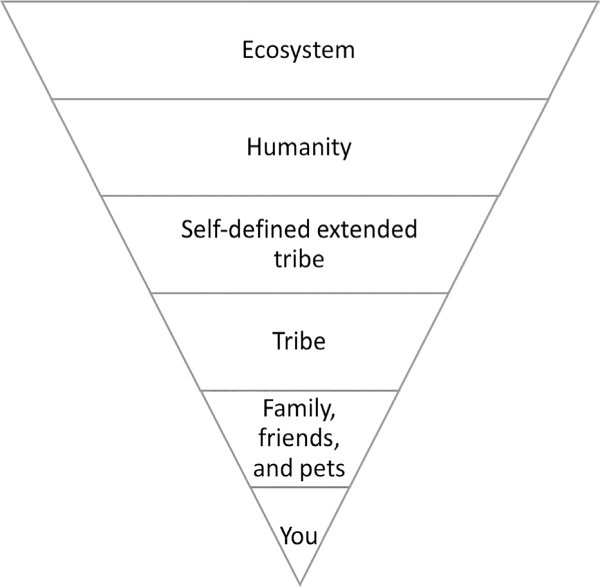
<p>所谓的 <strong>layer</strong>，见下图，自下向上依次为：</p>

<ul>
  <li>自我</li>
  <li>家人、朋友、宠物</li>
  <li>部落（侧重血缘或地缘）</li>
  <li>与自己价值观、信念、理念或兴趣相容的团体</li>
  <li>人类</li>
  <li>生态系统</li>
</ul>

<p><img src="/assets/images/2025-06-02/higher-layer.jpg" alt="higher-layer" /></p>

<p>想到了下面这段话：</p>

<blockquote>
  <p>古之所谓豪杰之士，必有过人之节。人情有所不能忍者，匹夫见辱，拔剑而起，挺身而斗，此不足为勇也。天下有大勇者，卒然临之而不惊，无故加之而不怒。此其所挟持者甚大，而其志甚远也。</p>

  <p>—— 苏轼，《留侯论》</p>
</blockquote>

<p>真正的勇气是需要代价的，而其中最高最大的代价就是个人的生命。所以那句调侃<strong>你都没有为我付出过，我怎么知道你是不是真的爱我</strong>，背后是有深刻含义的。</p>

<p>古代时在外领兵的将军，是要把自己的儿子置于皇帝眼皮底下的，其实是一种人质的做法。以将军的儿子作为代价，保证他不会谋反。</p>

<p>高耀洁为了向公众普及艾滋病防治知识，面对的艰辛和不被理解，是需要巨大勇气的。过去想不不明白，这样为了所谓更大范围的（不认识的）群体的福祉，却伤害到自己身边的亲人的事情，为什么她会坚持着做下去。</p>

<p>相反地，那些为了获得自己的利益，而把其他人的生命作为代价交换的行为是绝对的懦夫行径。</p>

<p>最近在看《伪装者》，那个过于残忍的死间计划，为了求得最后的胜利，王天风不仅牺牲了自己的生命，还拿自己的名誉作为代价。这样的人才拥有至高无上的荣誉。</p>

<p>张寒寺写过一个故事——《男朋友典当行》。在这个故事里，男朋友是可以拿去典当的。但是赎回的时候，需要付出更大的代价。同样地，付出过真金白银、或者切身代价后所得到的东西，人才会更加珍惜。</p>

<p>以及，虚拟的生活，为什么不能等同于真实的生活？因为在虚拟生活中的死亡并不代表真的死亡；虚拟生活中的破产并不是真正意义上的破产，所以人无法带着真实生活中的情感和判断，进入虚拟生活。他会想着，这毕竟是假的，所以他的行为并不一定和真正的现实的生活中的行为一致。</p>

<blockquote>
  <p>公孙杵臼曰：“立孤与死孰难？”程婴曰：“死易，立孤难耳。”公孙杵臼曰：“赵氏先君遇子厚，子强为其难者，吾为其易者，请先死。”</p>
</blockquote>

<p>在《赵氏孤儿》，死反而成了简单的事情。而活着的人，需要去做更难的事情。</p>

<h2 id="revealed-preference揭示偏好">Revealed Preference（揭示偏好）</h2>

<blockquote>
  <p>Revealed Preference 经济学中的一个重要概念，用来<strong>通过人们的实际行为来推断其偏好</strong>，而不是依赖他们口头上的表达或问卷调查的回答。</p>
</blockquote>

<p>翻译成一句白话就是，<strong>不看一个人说什么，看他做什么</strong>。</p>

<p>只有把一个人真正地置于某种情况下，他做出的选择才能最准确反应他的偏好。而所谓的<strong>如果在……的情况下，你会怎么做呢？</strong>这种提问的方式其实是没有任何实际意义的（或许有迷惑人的意义）。</p>

<h2 id="如何从我做起">如何从我做起</h2>

<p>知行合一，从王阳明起到现在已经 500 多年了。期间多少人提到它，又多少人真正做到了。如今的生活并不像以上列举的那样原始和暴力，并不需要常常面对生死问题。但这本书所关注的焦点——承担责任和风险仍然是有实际意义的。它关乎一个人的道德追求，所谓有所为有所不为。</p>

<p>承担风险的人才是真正在生活。不愿意承担风险，就只能在游戏中兜兜转转。</p>

<h2 id="参考资料">参考资料</h2>

<h3 id="摘录书中关于勇气的描述">摘录书中关于勇气的描述</h3>

<ul>
  <li>Courage (risk taking) is the highest virtue. 勇气（承担风险）是最高的美德。</li>
  <li>Taking personal risks to save the collective are “courage” and “prudence” since you are lowering risks for the collective. 为集体利益而承担个人风险的行为，既是”勇气的彰显”，也是”明智之举”，因为此举能降低群体面临的风险。</li>
  <li>I can exercise courage to save a collection of kids from drowning, at the risk of my own life, and it would also correspond to a form of prudence. Were I to die, I would be sacrificing a lower layer in Figure 6 for the sake of a higher one. 我可以冒着生命危险，勇敢地救起一群溺水的孩子——这种行为既是勇气的体现，也是一种深层次的审慎。若我不幸牺牲，那将是用图6中较低层级的价值，换取更高层级的价值。</li>
  <li>Selfish courage is not courage. A foolish gambler is not committing an act of courage, especially if he is risking other people’s funds or has a family to feed. 自私的勇敢并非真勇敢。一个鲁莽的赌徒算不上勇敢——尤其当他押上别人的钱财，或家中尚有妻儿待哺之时。</li>
  <li>Virtue devoid of courage, sacrifice, and skin in the game is never virtue. 所谓美德缺乏勇气、不愿牺牲、不敢亲身涉险，那便根本称不上美德。</li>
</ul>

<h3 id="skin-in-the-game-致敬的两位有勇气的人">skin in the game 致敬的两位有勇气的人</h3>

<ul>
  <li>Ron Paul：是当代极少数在政治上<strong>真正做到言行一致、敢于承担风险和责任</strong>的人。在其长期从政生涯中始终坚持原则。即便他的观点（例如反战、批评美联储、反对大政府）不受欢迎、对他不利，他也从不妥协。</li>
  <li>Ralph Nader：
    <ul>
      <li>作者的原话：The Ralph Nader to whom I dedicate this book is the Ralph Nader who helped establish the legal mechanism to protect consumers and citizens from predators. 在本书中致敬的是那位帮助建立了保护消费者和公民免受掠夺者（大公司、大机构）侵害的法律机制的拉尔夫·纳德。几十年来他始终如一地坚持自由意志主义原则，包括外交政策、财政纪律、公民自由和“健全货币”（例如恢复金本位）。</li>
      <li>纳德通过《任何速度都不安全》等著作，揭露汽车安全问题，引领启动了汽车召回制度，促成了国家交通和机动车安全法的制定。为此，他遭到通用汽车的调查，自己的生活受到了很大影响，甚至有人往他家里打陌生电话，对方企图破坏他的声誉，但他也没有放弃这件事情，直到最终把它做成，成功维护了自己的名誉。同时，作为现代消费者权益之父，他创立了消费者权益保护组织，致力于捍卫广大消费者的权益。纳德不仅影响了美国社会和法律体系的发展，还在促进公共政策的制定和环境问题的解决方面发挥了积极作用。</li>
      <li>参考链接：https://www.qwyw.org/archives/5764</li>
    </ul>
  </li>
</ul>]]></content><author><name></name></author><category term="阅读随笔" /><summary type="html"><![CDATA[勇气是唯一不可伪造的美德]]></summary></entry><entry><title type="html">后弯的供求曲线</title><link href="/%E7%BB%8F%E6%B5%8E/2025/03/25/%E5%90%8E%E5%BC%AF%E7%9A%84%E4%BE%9B%E6%B1%82%E6%9B%B2%E7%BA%BF.html" rel="alternate" type="text/html" title="后弯的供求曲线" /><published>2025-03-25T15:05:53+00:00</published><updated>2025-03-25T15:05:53+00:00</updated><id>/%E7%BB%8F%E6%B5%8E/2025/03/25/%E5%90%8E%E5%BC%AF%E7%9A%84%E4%BE%9B%E6%B1%82%E6%9B%B2%E7%BA%BF</id><content type="html" xml:base="/%E7%BB%8F%E6%B5%8E/2025/03/25/%E5%90%8E%E5%BC%AF%E7%9A%84%E4%BE%9B%E6%B1%82%E6%9B%B2%E7%BA%BF.html"><![CDATA[<h1 id="后弯的供求曲线">后弯的供求曲线</h1>

<p>最近看完了一本书，《数字泡沫》。对书中内容印象最深的是<strong>后弯的供求曲线</strong>。下面首先简要介绍下经典的供求曲线，再介绍后弯的供求曲线和它所反映的供求关系。</p>

<h2 id="经典供求曲线">经典供求曲线</h2>

<p>经典经济学理论认为，</p>

<blockquote>
  <p>商品的价格越高，则购买方对它的需求量就越少，生产方生产它的意愿就越强。</p>

  <p>商品价格越低，则购买方对它的需求量就会增大，而生产方生产它的意愿就会减少。</p>

  <p>当商品在某个价格上，购买方愿意购买的数量与生产方愿意生产的数量相等时，称为达到了这个商品市场的市场均衡，此时商品的价格称为均衡价格，商品的生产量（消费量）称为均衡数量。</p>
</blockquote>

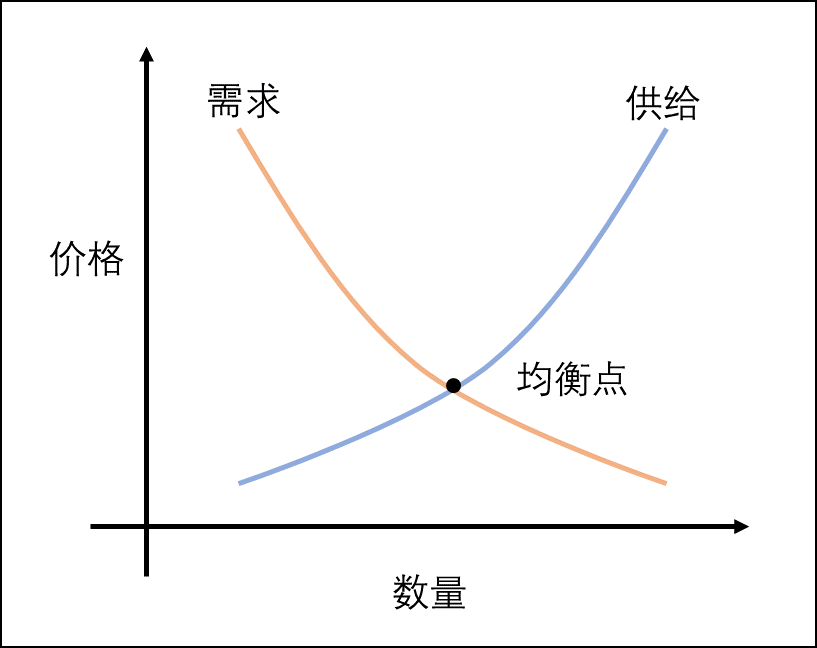
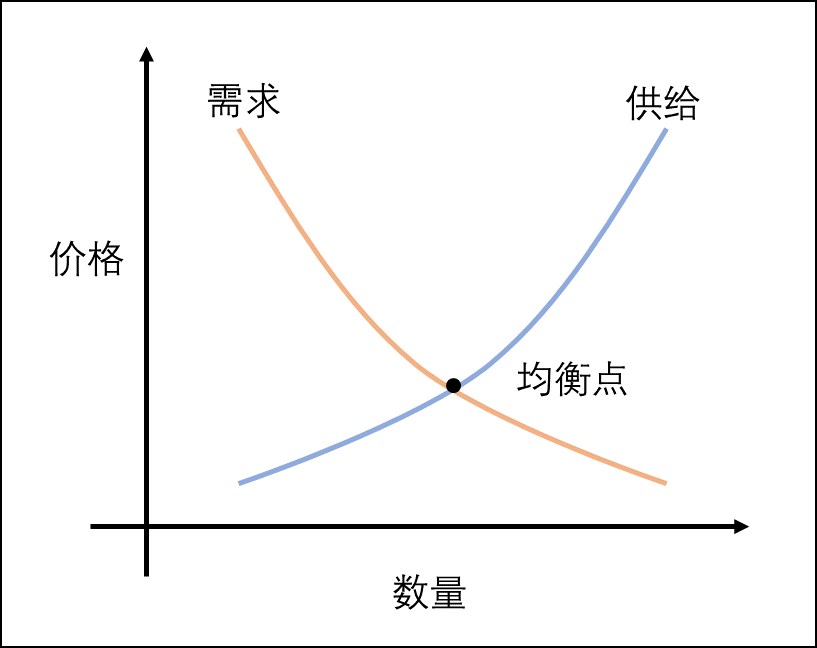
<p>经典供求曲线的示意图如下：</p>

<p><img src="/assets/images/2025-03-25/image-20250224231231417.png" alt="image-20250224231231417" /></p>

<p>在经典经济学理论中，市场调节机制会使得商品价格<strong>自发达到均衡点</strong>。均衡形成的过程分为以下两种情况：</p>

<ol>
  <li>当市场价格高于均衡价格时，供给量大于需求量，导致商品过剩。生产者为出售过剩商品，会降低价格。价格下降促使需求量增加、供给量减少，直到供给需求相当，此时价格即为均衡价格。</li>
  <li>当市场价格低于均衡价格时，需求量大于供给量，导致商品短缺。消费者为获得商品，竞相出高价，推动价格上涨。价格上涨促进供给量增加、需求量减少，直到供给量和需求量相当，此时价格即为均衡价格。</li>
</ol>

<p>现实经济活动的供需关系，是一个动态的过程，市场价格在均衡价格附近波动，只能从供需关系中得到价格波动的曲线，估算出均衡价格。不同种类的商品，波动幅度会有不同。</p>

<p>作为日常生活消费品的商品，基本符合这类供求关系，例如肉价、菜价、服装等。</p>

<h2 id="什么是后弯">什么是后弯</h2>

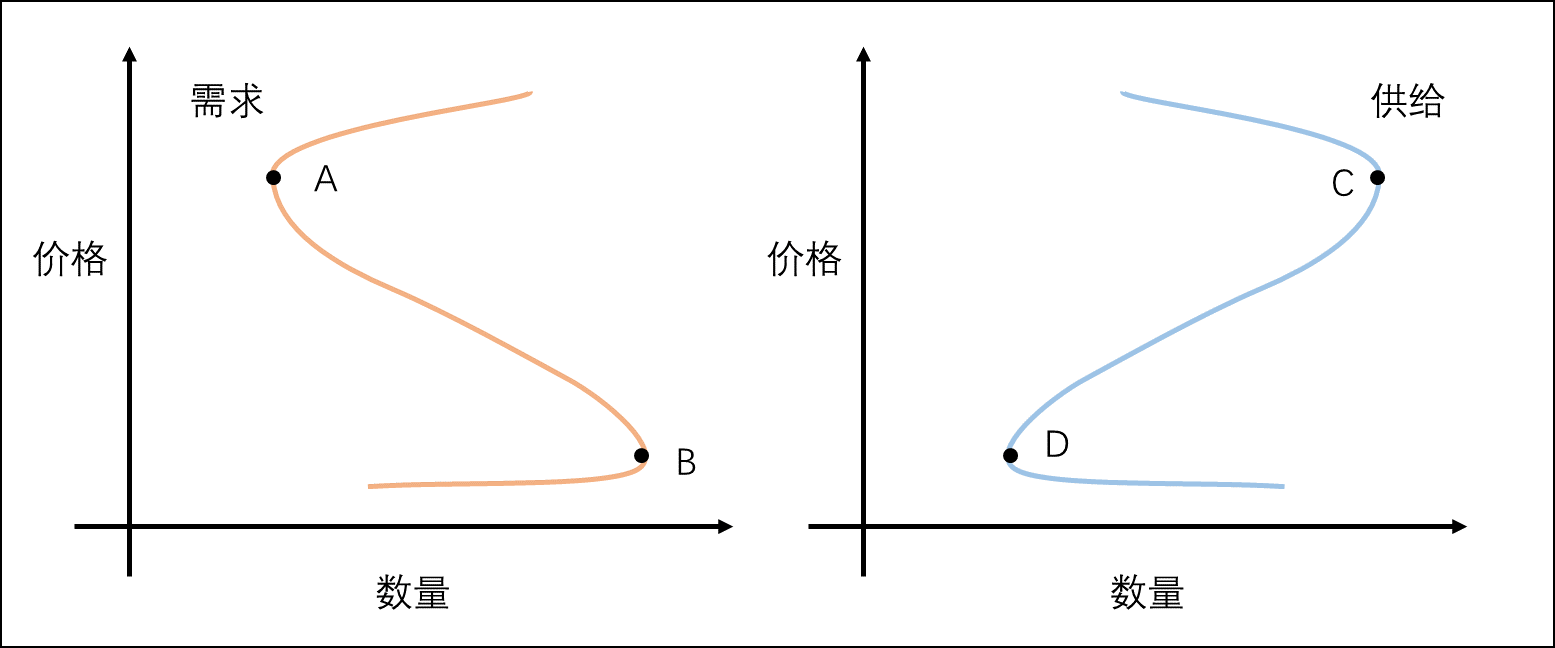
<p>后弯供求曲线，称为<strong>Backward-bending/supply curve</strong>。它的样子大体上如下，我们分别画出后弯的供给曲线和后弯的需求曲线。</p>

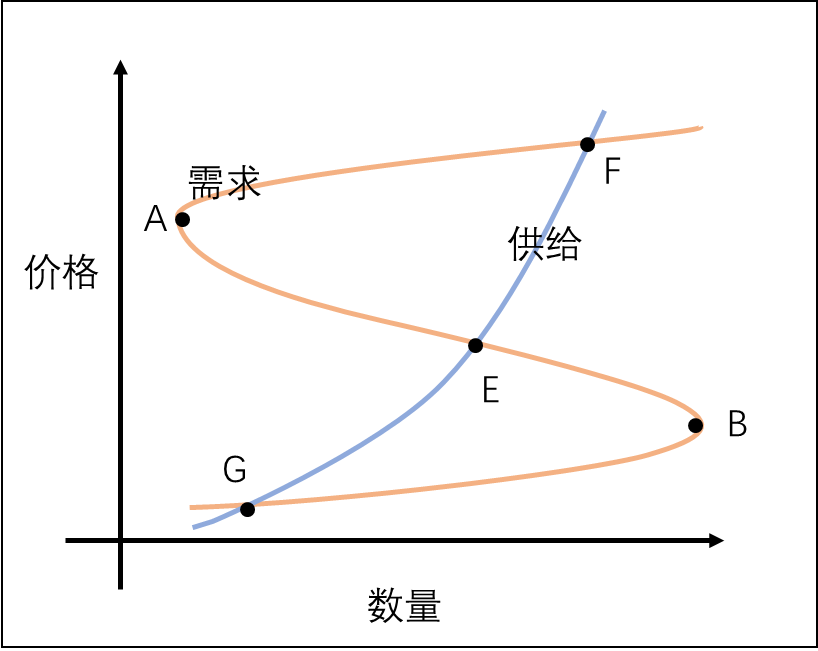
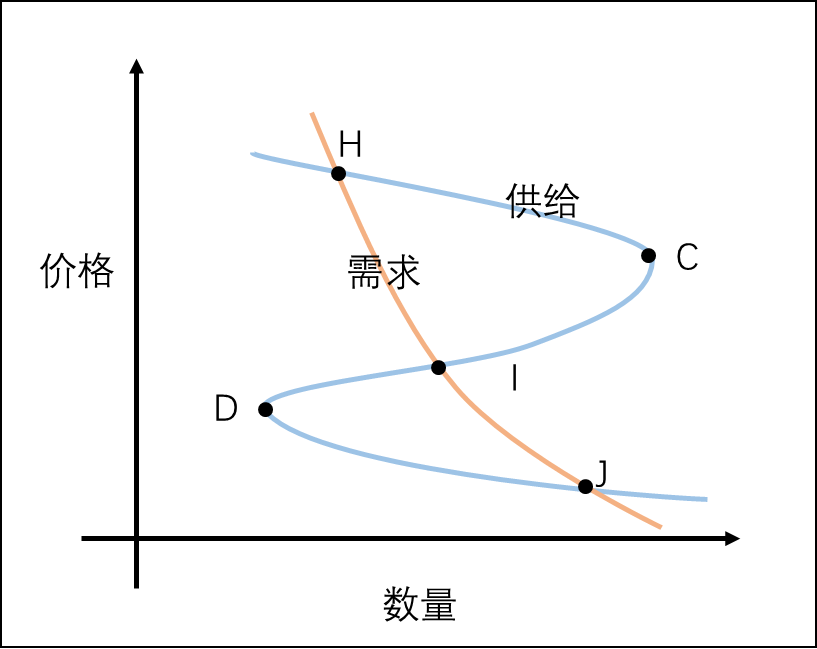
<p><img src="/assets/images/2025-03-25/image-20250224231243060.png" alt="image-20250224231243060" /></p>

<p><strong>后弯的需求曲线</strong></p>

<p>后弯需求曲线的特点是，在经典需求曲线的基础上，当价格超过某一高点（例如 A 点）时，需求量不减反增；而当价格低于某个低点（例如 B 点）时，需求量不增反减。</p>

<p><strong>后弯的供给曲线</strong></p>

<p>类似地，后弯供给曲线的特点是，在经典供给曲线的基础上，当价格超过某一高点（例如 C 点）时，供给量不增反减；而当价格低于某个低点（例如 D 点）时，供给量不减反增。</p>

<h2 id="供求曲线组合">供求曲线组合</h2>

<p>由经典供求曲线和后弯供求曲线组合，得到四种组合结果：</p>

<ul>
  <li>经典供给曲线、经典需求曲线；</li>
  <li>经典供给曲线、后弯需求曲线；</li>
  <li>后弯供给曲线、经典需求曲线；</li>
  <li>后弯供给曲线、后弯需求曲线。</li>
</ul>

<p>且供给和需求曲线相交的位置不同，还会有不同的交点数量，即不同的均衡价格。</p>

<h3 id="经典供给曲线--经典需求曲线">经典供给曲线 &amp; 经典需求曲线</h3>

<p><img src="/assets/images/2025-03-25/image-20250324233022594.png" alt="image-20250324233022594" /></p>

<p>这种情况下，一般都有一个均衡点，此时供求关系在市场的调节机制下，最终达到均衡。</p>

<h3 id="经典供给曲线后弯需求曲线">经典供给曲线、后弯需求曲线</h3>

<p><img src="/assets/images/2025-03-25/image-20250324235148670.png" alt="image-20250324235148670" /></p>

<p>需求曲线后弯，意味着在需求量随价格上升而减小的变化趋势发展到一定程度时（价格高于点A处的价格），当价格继续上升时，需求反而增加；或者在需求量随价格降低而增加的趋势发展到一定程度时（价格低于B点的价格），当价格继续降低时，需求量反而下降。这时如果供给曲线是经典的供给曲线时，可能形成如上图中的三个均衡点（E、F、G）。</p>

<p>后弯需求曲线的一个例子是，股票市场的恐慌性需求和投机性需求。例如，某只股票一直在涨，一开始由于价格上涨，股民可能嫌弃股票贵而减少购买量或选择不买，但当它的价格继续一直上涨，可能反而出现需求暴增的情况。相应地，当股票价格下跌时，有人抄底，但当价格持续下跌，超过某个值时，可能引发恐慌，导致需求量骤减。</p>

<h3 id="后弯供给曲线经典需求曲线">后弯供给曲线、经典需求曲线</h3>

<p><img src="/assets/images/2025-03-25/image-20250324235550733.png" alt="image-20250324235550733" /></p>

<p>供给曲线后弯，意味着在供给量随价格上升而增加的变化趋势发展到一定程度时（价格高于点C处的价格），当价格继续上升时，供给量反而减少；或者在供给量随价格降低而减少的趋势发展到一定程度时（价格低于D点的价格），当价格继续降低时，供给量反而增加。这时如果需求曲线是经典的供给曲线时，可能形成如上图中的三个均衡点（H、I、J）。</p>

<p>后弯供给曲线的例子有两个，一个是劳动供给，一个是20世纪70年代的石油危机时的石油供给。</p>

<p>劳动力供给曲线是典型的后弯供给曲线，它反映劳动供给量随工资上升先增加而后逐渐减少的特征。《数字泡沫》第五章，《供需曲线的扭曲与定价权理论》一节中援引的解释是，</p>

<blockquote>
  <p>劳动供给取决于工资变动所引起的替代效应和收入效应。随着工资的增加，由于替代效应的作用，家庭用工作代替闲暇，从而劳动供给增加。</p>

  <p>同时随着工资增加，由于收入效应的作用，家庭需要需要更多的闲暇，从而劳动供给减少。</p>

  <p>当替代效应大于收入效应时，劳动供给随工资增加而增加；当收入效应大于替代效应时，劳动供给随工资增加而减少。</p>

  <p>一般规律是，当工资较低时，替代效应大于收入效应；当工资达到某个较高水平时，收入效应大于替代效应。</p>
</blockquote>

<p>石油的供给曲线后弯，需要联系货币本位变化说明。从最初的金、银、铜作为货币，到1971年8月15日尼克松政府宣布美元与黄金完全脱钩之前，货币都是作为一种稀缺资源存在的，即使是作为纸币的现代货币，在那之前也都是最终与一定数量的黄金储备挂钩的。但是从美元与黄金脱钩开始到现在，货币增发、通货膨胀、量化宽松等一系列货币政策带来的结果是，货币本身的稀缺性其实是越来越弱了。这样财富就有了向更稀缺的资源集中的诉求——石油就是现代社会最稀缺的资源的代表。</p>

<p>或者从另一个角度看，金本位时代的货币，由于有黄金产量的限制，货币数量有可见的上限。这样的货币数量上限的限制下，供求曲线基本都是一段单调的曲线。但是当货币不再与黄金挂钩时，货币数量是可以无限增发的（事实上目前也是这么做的，增发速度还在加快）。在这样巨量的货币规模下，供求曲线已经延申到了突破了经典理论的范围，发生了后弯。</p>

<p>供给曲线的高位后弯，是一种屯居奇货的行为。而供给曲线在低位的后弯，还是可以举股票市场的例子，价格大跌时恐慌情绪蔓延，大量抛售，价格越低供给反而增加。</p>

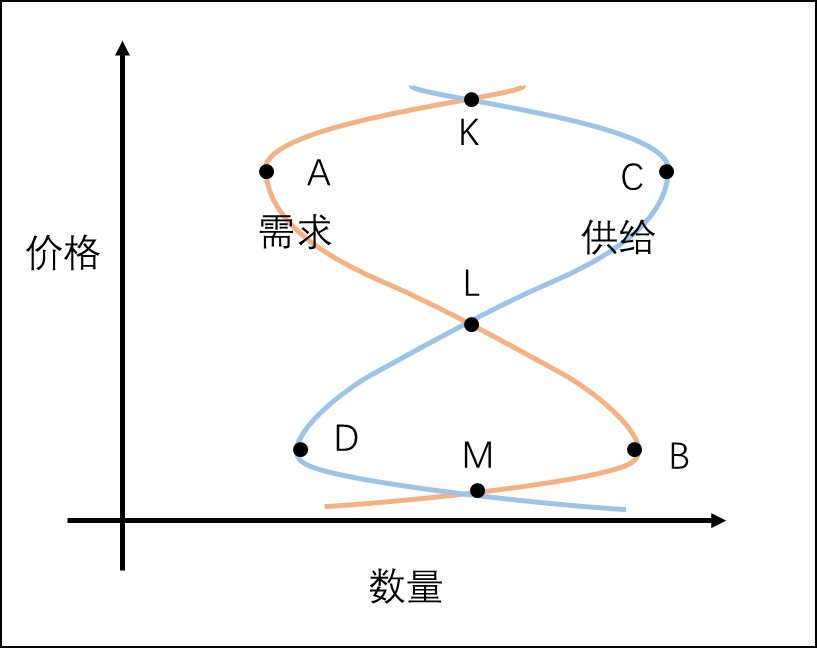
<h3 id="后弯供给曲线后弯需求曲线">后弯供给曲线、后弯需求曲线</h3>

<p><img src="/assets/images/2025-03-25/image-20250325220858786.png" alt="image-20250325220858786" /></p>

<p>同时后弯的供给和需求，这里只是按照分类方法画了出来。它的具体应用场景还需要根据现实中的经济活动去分析。</p>

<h2 id="后弯之后怎样">后弯之后怎样</h2>

<p>供求曲线发生后弯，归根到底是货币脱离金本位之后可以无限增发的可能。这样货币的稀缺性和一般等价物能力都会逐渐被削弱。财富为了保值，会转移到更具有稀缺性的实体上。</p>

<h2 id="参考资料">参考资料</h2>

<p>《数字泡沫：虚拟经济交易学》，张捷，9787507557411</p>]]></content><author><name></name></author><category term="经济" /><summary type="html"><![CDATA[后弯的供求曲线]]></summary></entry><entry><title type="html">the use of knowledge in society 中文翻译</title><link href="/%E7%BF%BB%E8%AF%91/2025/02/16/the_use_of_knowledge_in_society_trans.html" rel="alternate" type="text/html" title="the use of knowledge in society 中文翻译" /><published>2025-02-16T15:05:53+00:00</published><updated>2025-02-16T15:05:53+00:00</updated><id>/%E7%BF%BB%E8%AF%91/2025/02/16/the_use_of_knowledge_in_society_trans</id><content type="html" xml:base="/%E7%BF%BB%E8%AF%91/2025/02/16/the_use_of_knowledge_in_society_trans.html"><![CDATA[<h1 id="the-use-of-knowledge-in-society-中文翻译">the use of knowledge in society 中文翻译</h1>

<p>by Friedrich A. Hayek</p>

<p>American Economic Review. XXXV, No. 4. pp. 519-30. American Economic Association</p>

<p><strong>copyright</strong>：</p>

<p>The text of this edition is copyright ©: 1945, American Economic Review, XXXV, No. 4; September, 1945, pp. 519-30. Reprinted with permission.</p>

<p>source：https://www.econlib.org/library/Essays/hykKnw.html</p>

<h2 id="part-i">part I</h2>

<p>What is the problem we wish to solve when we try to construct a rational economic order? On certain familiar assumptions the answer is simple enough. <em>If</em> we possess all the relevant information, <em>if</em> we can start out from a given system of preferences, and <em>if</em> we command complete knowledge of available means, the problem which remains is purely one of logic. That is, the answer to the question of what is the best use of the available means is implicit in our assumptions. The conditions which the solution of this optimum problem must satisfy have been fully worked out and can be stated best in mathematical form: put at their briefest, they are that the marginal rates of substitution between any two commodities or factors must be the same in all their different uses.</p>

<p>当我们想要构建一个合理的经济秩序时，是为了决什么问题呢？在几个熟悉的假设基础上，答案显而易见：如果我们拥有所有相关的信息，如果我们可以从任一种给定的偏好系统出发，并且，如果我们我们掌握了关于可用手段的全部知识，那么剩下的问题就纯粹是一个逻辑问题——我们的假设中隐含了这样一个问题——什么是现有手段的最佳利用方式？已经有人对这个最优化问题的解必须满足的条件进行了充分研究，这一条件用数学形式表示最为恰当。简单来说，这个条件就是：</p>

<blockquote>
  <p>任何两种商品或要素之间的边际替代效率在它们的所有用途中必须是相同的。</p>
</blockquote>

<p>This, however, is emphatically <em>not</em> the economic problem which society faces. And the economic calculus which we have developed to solve this logical problem, though an important step toward the solution of the economic problem of society, does not yet provide an answer to it. The reason for this is that the “data” from which the economic calculus starts are never for the whole society “given” to a single mind which could work out the implications and can never be so given.</p>

<p>但是，这显然不是社会所面临的经济问题。我们为解决这个逻辑问题所发明的经济计算方法，虽然是解决社会面临的经济问题的重要一步，但目前并没有提供一个（令人信服的）答案。这是因为，经济计算所依据的来自全社会的数据过去根本不曾被提供给一个单一的组织，以使他们发现其中隐含的联系。并且，这种单一组织以后永远也没有办法获得这样的数据。</p>

<p>The peculiar character of the problem of a rational economic order is determined precisely by the fact that the knowledge of the circumstances of which we must make use never exists in concentrated or integrated form but solely as the dispersed bits of incomplete and frequently contradictory knowledge which all the separate individuals possess. The economic problem of society is thus not merely a problem of how to allocate “given” resources—if “given” is taken to mean given to a single mind which deliberately solves the problem set by these “data.” It is rather a problem of how to secure the best use of resources known to any of the members of society, for ends whose relative importance only these individuals know. Or, to put it briefly, it is a problem of the utilization of knowledge which is not given to anyone in its totality.</p>

<p>合理的经济秩序这一问题的特有属性是由以下事实决定的：我们必须利用的关于经济环境的知识从来不是以集中式的形式存在的，而是以不完整的、且常常相互矛盾的分散片段存在——这些分散片段为众多（参与经济活动的）个体所拥有。因此，我们社会的经济问题不仅仅是如何分配给定资源的问题（如果给定是指，把数据抛给某个组织，让它来解决需要解决的问题）。相反，它是一个如何确保最佳地利用所有社会成员都知道的资源的问题。这些资源的相对重要性只有这些需要使用它的个体知道。或者，简而言之，这是一个如何最大化利用这种没有哪个个体能够完全掌握的知识的问题。</p>

<p>This character of the fundamental problem has, I am afraid, been obscured rather than illuminated by many of the recent refinements of economic theory, particularly by many of the uses made of mathematics. Though the problem with which I want primarily to deal in this paper is the problem of a rational economic organization, I shall in its course be led again and again to point to its close connections with certain methodological questions. Many of the points I wish to make are indeed conclusions toward which diverse paths of reasoning have unexpectedly converged. But, as I now see these problems, this is no accident. It seems to me that many of the current disputes with regard to both economic theory and economic policy have their common origin in a misconception about the nature of the economic problem of society. This misconception in turn is due to an erroneous transfer to social phenomena of the habits of thought we have developed in dealing with the phenomena of nature.</p>

<p>我认为，近些年许多的经济理论的深化，特别是许多对数学工具的使用，反而使这一基本问题的这个特征（注：知识不由某个单个组织掌握，而是分散在整个社会中）变得更加晦涩模糊而不是阐述得更加清晰。尽管我在本文中主要想讨论的是合理的经济组织的问题，但在讨论过程中我将一再指出它与某些方法论问题的密切联系。我的许多观点其实是许多不同推理思路出乎意料地得出的共同结论。但，正如我对这些问题的看法一样，我认为这不是巧合。我认为，现在许多关于经济理论和经济政策的争论都有一个共同的根源——这些人都误解了我们社会的经济问题的本质。这种误解是由于我们把处理自然现象时养成的思维习惯错误地应用到了社会现象上。</p>

<h2 id="part-ii">part II</h2>

<p>In ordinary language we describe by the word “planning” the complex of interrelated decisions about the allocation of our available resources. All economic activity is in this sense planning; and in any society in which many people collaborate, this planning, whoever does it, will in some measure have to be based on knowledge which, in the first instance, is not given to the planner but to somebody else, which somehow will have to be conveyed to the planner. The various ways in which the knowledge on which people base their plans is communicated to them is the crucial problem for any theory explaining the economic process, and the problem of what is the best way of utilizing knowledge initially dispersed among all the people is at least one of the main problems of economic policy—or of designing an efficient economic system.</p>

<p>日常用语中，我们用<strong>计划</strong>一词描述关于如何分配可用资源这一问题的一系列相互关联的复杂决策。从这个意义上说，所有的经济活动其实都是一种计划。在多方合作的社会中，无论是哪个组织来制定计划，这项计划都在一定程度上依赖于那些最初并不由计划制定者掌握的知识——这些知识最初由其他人掌握，然后通过某种方式传到了计划制定者那里。这种作为计划参考依据的知识通过怎样的方式传到计划制定者那里，是所有解释经济过程的理论中至关重要的问题。而寻找那些利用最初散落在所有个体中的知识的最佳方法，是经济政策中最主要的问题之一，也是设计高效经济系统必须解决的最主要问题之一。</p>

<p>The answer to this question is closely connected with that other question which arises here, that of <em>who</em> is to do the planning. It is about this question that all the dispute about “economic planning” centers. This is not a dispute about whether planning is to be done or not. It is a dispute as to whether planning is to be done centrally, by one authority for the whole economic system, or is to be divided among many individuals. Planning in the specific sense in which the term is used in contemporary controversy necessarily means central planning—direction of the whole economic system according to one unified plan. Competition, on the other hand, means decentralized planning by many separate persons. The halfway house between the two, about which many people talk but which few like when they see it, is the delegation of planning to organized industries, or, in other words, monopoly.</p>

<p>以上问题的答案与下面的这一问题密切相关：</p>

<blockquote>
  <p>由谁来制定计划？</p>
</blockquote>

<p>所有关于经济计划的争议都集中在这个问题上。这不是关于是否需要计划的问题，而是关于应该由一个权威机构为整个经济系统制定计划，还是应该分别由多个组织制定计划。在现代社会饱受争议的特定情境下，<strong>计划</strong>意味着中心化的计划——根据一个统一的计划对经济系统进行指导。另一方面，<strong>竞争</strong>意味着由参与经济活动的相互独立的个体制定的去中心化的计划。两者之间的折中方案，是许多人谈论，但很少有人喜欢的方式：将计划的责任委托给组织良好的企业，即垄断。</p>

<p>Which of these systems is likely to be more efficient depends mainly on the question under which of them we can expect that fuller use will be made of the existing knowledge. And this, in turn, depends on whether we are more likely to succeed in putting at the disposal of a single central authority all the knowledge which ought to be used but which is initially dispersed among many different individuals, or in conveying to the individuals such additional knowledge as they need in order to enable them to fit their plans with those of others.</p>

<p>这些计划模式中，哪种更为高效呢？这取决于在哪种模式下我们能够更多地利用到分散于经济系统中的知识。</p>

<p>而后者又取决于下面两种情况中，我们采取哪一种更可能成功：</p>

<ol>
  <li>把所有最初散落在许多个体中的知识交由一个中心化权威组织使用；</li>
  <li>把这些知识交由那些需要它们的个体，以使他们根据其他人的计划调整自己的计划。</li>
</ol>

<h2 id="part-iii">part III</h2>

<p>It will at once be evident that on this point the position will be different with respect to different kinds of knowledge; and the answer to our question will therefore largely turn on the relative importance of the different kinds of knowledge; those more likely to be at the disposal of particular individuals and those which we should with greater confidence expect to find in the possession of an authority made up of suitably chosen experts. If it is today so widely assumed that the latter will be in a better position, this is because one kind of knowledge, namely, scientific knowledge, occupies now so prominent a place in public imagination that we tend to forget that it is not the only kind that is relevant. It may be admitted that, as far as scientific knowledge is concerned, a body of suitably chosen experts may be in the best position to command all the best knowledge available—though this is of course merely shifting the difficulty to the problem of selecting the experts. What I wish to point out is that, even assuming that this problem can be readily solved, it is only a small part of the wider problem.</p>

<p>很明显，关于上文提到的计划模式的问题，持有不同种类的知识的人会有不同的立场。这个问题的答案主要取决于不同种类知识的相对重要程度——那些更有可能由个体占有的知识和那些我们希望由精心选择的专家构成的权威团体发现的知识。在现代，假如我们认为后者更有优势的话，那是因为一种称为科学知识的知识在公众想象中占据了极为的位置，以至于公众忘记了科学知识并不是唯一一种与经济模式密切相关的知识。我们不得不承认，就科学知识而言，由经过适当挑选的专家组成的机构最有可能掌握所有可用的最佳知识——尽管这种选项其实是将困难转移到专家选拔问题上。我希望指出的是，就算我们假设这个问题可以被轻而易举地解决，它也只是那个更广大问题的一小部分。</p>

<p>Today it is almost heresy to suggest that scientific knowledge is not the sum of all knowledge. But a little reflection will show that there is beyond question a body of very important but unorganized knowledge which cannot possibly be called scientific in the sense of knowledge of general rules: the knowledge of the particular circumstances of time and place. It is with respect to this that practically every individual has some advantage over all others because he possesses unique information of which beneficial use might be made, but of which use can be made only if the decisions depending on it are left to him or are made with his active coöperation. We need to remember only how much we have to learn in any occupation after we have completed our theoretical training, how big a part of our working life we spend learning particular jobs, and how valuable an asset in all walks of life is knowledge of people, of local conditions, and of special circumstances. To know of and put to use a machine not fully employed, or somebody’s skill which could be better utilized, or to be aware of a surplus stock which can be drawn upon during an interruption of supplies, is socially quite as useful as the knowledge of better alternative techniques. And the shipper who earns his living from using otherwise empty or half-filled journeys of tramp-steamers, or the estate agent whose whole knowledge is almost exclusively one of temporary opportunities, or the <em>arbitrageur</em> who gains from local differences of commodity prices, are all performing eminently useful functions based on special knowledge of circumstances of the fleeting moment not known to others.</p>

<p>今天，如果有人说，科学知识并不等于所有知识的总和，这种观点无疑会被当成异端邪说。但是，只要稍加思索我们就会看到，毫无疑问地，宇宙中存在一大类非常重要但是分散杂乱的知识——以关于知识的一般规则来看，这类知识并不能被称为科学知识——它们是，关于某时某地的具体情境的知识。正是在这一点上，每个人都比其他人更具有一些优势，因为他有一些可以从中获益的特有信息——但仅仅当依赖于这个信息的决策由他或他的合作伙伴做出时，他才有从中获益的可能。回忆一下，当我们完成理论训练之后（接受社会规定的教育之后），我们在未来职业中还需要学习多少新东西，我们在自己的工作中有多大一部分时间是在学习特定工作技能，以及对人的理解、对周围环境的理解和对特定情境的理解是我们成长多么宝贵的财富。了解并使用那些并未充分使用的机器，或者雇佣那些尚未更好发挥自己能力的员工，或者掌握在供应中断时随时可利用的剩余库存，从社会价值上来说，与掌握关于更好的替代技术的知识是同等重要的。以使用空的或者半满的轮船为生的托运人，全部知识几乎完全来自于短期机会的地产代理商，以及从商品价格地区差异中获利的套利者——他们都基于对其他人不知道的转瞬即逝的情况的特别了解，在履行非常有用的社会职能。</p>

<p>It is a curious fact that this sort of knowledge should today be generally regarded with a kind of contempt and that anyone who by such knowledge gains an advantage over somebody better equipped with theoretical or technical knowledge is thought to have acted almost disreputably. To gain an advantage from better knowledge of facilities of communication or transport is sometimes regarded as almost dishonest, although it is quite as important that society make use of the best opportunities in this respect as in using the latest scientific discoveries. This prejudice has in a considerable measure affected the attitude toward commerce in general compared with that toward production. Even economists who regard themselves as definitely immune to the crude materialist fallacies of the past constantly commit the same mistake where activities directed toward the acquisition of such practical knowledge are concerned—apparently because in their scheme of things all such knowledge is supposed to be “given.” The common idea now seems to be that all such knowledge should as a matter of course be readily at the command of everybody, and the reproach of irrationality leveled against the existing economic order is frequently based on the fact that it is not so available. This view disregards the fact that the method by which such knowledge can be made as widely available as possible is precisely the problem to which we have to find an answer.</p>

<p>一个奇怪的事实是，掌握这种知识的行为在今天普遍被大众鄙视，并且任何通过利用这种知识获得比掌握更好的理论或技术知识的人更好的优势的行为，都被认为是一种不光彩的行为。从掌握的关于通信和运输设施方面的优势信息中获益有时被认为是不诚实的行为，尽管事实上利用最佳的机会与利用最新的科学发现对于社会发展同样重要。这一偏见在很大程度上影响了公众对商业活动与生产活动的普遍态度。即使是那些自认为不会受到过去粗糙的唯物主义谬论影响的经济学家，在面对与获取这种实用知识相关的活动时，也经常会犯同样的错误。显然在这些经济学家对于知识的理解中，这类实用知识被认为是<strong>非原创的</strong>（给予的，拿来的）。目前普遍的看法是，所有这类实际知识理所当然应该为每个人掌握，并且对现有经济秩序的非理性指摘往往是基于这样视角——这样的实际知识往往并不是为每个人所掌握的（他们认为这是不合理的）。这种观点忽略了这样一个事实：寻找让这些知识尽可能广泛传播的方法，正是我们需要寻找的答案。</p>

<h2 id="part-iv">part IV</h2>

<p>If it is fashionable today to minimize the importance of the knowledge of the particular circumstances of time and place, this is closely connected with the smaller importance which is now attached to change as such. Indeed, there are few points on which the assumptions made (usually only implicitly) by the “planners” differ from those of their opponents as much as with regard to the significance and frequency of changes which will make substantial alterations of production plans necessary. Of course, if detailed economic plans could be laid down for fairly long periods in advance and then closely adhered to, so that no further economic decisions of importance would be required, the task of drawing up a comprehensive plan governing all economic activity would be much less formidable.</p>

<p>如今，最小化这种关于某时某地具体情境知识的重要性似乎成了一种风尚，这与当下对交换过程不够重视密切相关。关于这种能够引起生产计划改变的交换的重要性和频率，计划制定者和他们的对手（对手是谁呢）的估计几乎没有太大差别。当然，如果可以制定足够长时间的详细的经济计划，并且能够比较严格地遵守计划，那样就不再需要什么特别重要的经济决策了。这样，提出一个综合全面的计划，控制所有经济活动就不再是艰巨的任务了。</p>

<p>It is, perhaps, worth stressing that economic problems arise always and only in consequence of change. So long as things continue as before, or at least as they were expected to, there arise no new problems requiring a decision, no need to form a new plan. The belief that changes, or at least day-to-day adjustments, have become less important in modern times implies the contention that economic problems also have become less important. This belief in the decreasing importance of change is, for that reason, usually held by the same people who argue that the importance of economic considerations has been driven into the background by the growing importance of technological knowledge.</p>

<p>或许，有必要强调一点，经济问题总是并且也只是产生于交换过程。如果事物是像过去那样发展到未来（联想牛顿第一定律），我们就只需要让它保持原状就好，根本不会产生新问题，也就不需要新的决策和计划。这种认为交换行为或者日常调整不再重要的信条，隐含着经济问题的重要性逐渐下降的观点。因此，持“交换过程重要性不断降低”持这种观点的人，同样也会认为经济问题的重要性已被日益重要的技术知识所淡化。</p>

<p>Is it true that, with the elaborate apparatus of modern production, economic decisions are required only at long intervals, as when a new factory is to be erected or a new process to be introduced? Is it true that, once a plant has been built, the rest is all more or less mechanical, determined by the character of the plant, and leaving little to be changed in adapting to the ever-changing circumstances of the moment?</p>

<p>是否，随着各种复杂精细的现代生产设备的出现，我们只需要长期经济决策就可以了吗？比例新建立一座工厂或者新引入一套操作流程。是否，当工厂建好之后，剩下的就只是一些为适应当前环境而进行的机械化的决策了吗？</p>

<p>The fairly widespread belief in the affirmative is not, as far as I can ascertain, borne out by the practical experience of the businessman. In a competitive industry at any rate—and such an industry alone can serve as a test—the task of keeping cost from rising requires constant struggle, absorbing a great part of the energy of the manager. How easy it is for an inefficient manager to dissipate the differentials on which profitability rests, and that it is possible, with the same technical facilities, to produce with a great variety of costs, are among the commonplaces of business experience which do not seem to be equally familiar in the study of the economist. The very strength of the desire, constantly voiced by producers and engineers, to be allowed to proceed untrammeled by considerations of money costs, is eloquent testimony to the extent to which these factors enter into their daily work.</p>

<p>就我所知，以上被广泛接受的观点并未得到商人群体的实际经验证实。无论如何，在一个存在竞争的行业里（这样的行业本身可以作为一个测试的例子），保持成本稳定就需要长期的挣扎努力，它会占用大量的管理资源。一个效率低下的经理如何消除利润所依赖的差异性，用相同的设备，如何能生产出具有不同成本的产品，是商业经验中最为常见的现象，但这些在经济学研究中却极少出现。生产商和工程师们一直强烈地希望能不考虑成本的束缚而进行工作，这种强烈愿望充分证明了这些因素在他们的日常工作中的影响程度。</p>

<p>One reason why economists are increasingly apt to forget about the constant small changes which make up the whole economic picture is probably their growing preoccupation with statistical aggregates, which show a very much greater stability than the movements of the detail. The comparative stability of the aggregates cannot, however, be accounted for—as the statisticians occasionally seem to be inclined to do—by the “law of large numbers” or the mutual compensation of random changes. The number of elements with which we have to deal is not large enough for such accidental forces to produce stability. The continuous flow of goods and services is maintained by constant deliberate adjustments, by new dispositions made every day in the light of circumstances not known the day before, by <em>B</em> stepping in at once when
<em>A</em> fails to deliver. Even the large and highly mechanized plant keeps going largely because of an environment upon which it can draw for all sorts of unexpected needs; tiles for its roof, stationery for its forms, and all the thousand and one kinds of equipment in which it cannot be self-contained and which the plans for the operation of the plant require to be readily available in the market.</p>

<p>经济学家越来越倾向于忽略最终形成整个经济环境的持续的微小的改变的一个原因是，他们对统计意义下的经济总体的关注度日益增长。而后者相比那些微观经济现象的变动，更具有稳定性（宏观统计结果忽略了微观波动的细节）。但是，统计学家们倾向采用的大数定律和随机变化的中和抵消模型，并不能解释经济总体的相对稳定。因为我们所应对的经济单元数量没有大到可以使经济总体表现出稳定性的数量（这里感觉有矛盾，宏观表现是稳定的，不就说明了统计意义下的稳定吗）。商品和服务的连续流动是通过不断的、有意识的调整来维持的，每天都会根据前一天未知的情况做出新的安排，当<em>A</em>未能交付时，<em>B</em>会立即介入。</p>

<p>即使是大型且高度机械化的工厂，也主要是因为它可以从市场上获取材料来满足它自身各种意想不到的需求，才能持续运行。无论是修补其屋顶的瓷砖，用于其业务需要的工具，还是它不能自给自足、但生产计划需要的所有一千零一种设备，这些材料都需要能在市场上随时获得。</p>

<p>This is, perhaps, also the point where I should briefly mention the fact that the sort of knowledge with which I have been concerned is knowledge of the kind which by its nature cannot enter into statistics and therefore cannot be conveyed to any central authority in statistical form. The statistics which such a central authority would have to use would have to be arrived at precisely by abstracting from minor differences between the things, by lumping together, as resources of one kind, items which differ as regards location, quality, and other particulars, in a way which may be very significant for the specific decision. It follows from this that central planning based on statistical information by its nature cannot take direct account of these circumstances of time and place and that the central planner will have to find some way or other in which the decisions depending on them can be left to the “man on the spot.”</p>

<p>或许，现在是我简要说明我一直思考的那种知识的时候了——那是一种无法通过统计方法获得的知识，所以也就无法以统计表格的形式呈现给权威机构。而这种权威机构依赖的统计数据必须经过抽象，排除掉事物之间的次要差异。这种统计数据忽略掉的质量、位置和其他属性，可能对于部分微观领域的经济活动具有特别的重要意义。所以，在统计数据基础上的集中型计划从根本上是无法考虑到这些微观经济领域的特殊情况的。因此，集中型计划的制定者们需要以某种方式让微观经济领域的实际参与者们可以自行决策。</p>

<h2 id="part-v">part V</h2>

<p>If we can agree that the economic problem of society is mainly one of rapid adaptation to changes in the particular circumstances of time and place, it would seem to follow that the ultimate decisions must be left to the people who are familiar with these circumstances, who know directly of the relevant changes and of the resources immediately available to meet them. We cannot expect that this problem will be solved by first communicating all this knowledge to a central board which, after integrating <em>all</em> knowledge, issues its orders. We must solve it by some form of decentralization. But this answers only part of our problem. We need decentralization because only thus can we insure that the knowledge of the particular circumstances of time and place will be promptly used. But the “man on the spot” cannot decide solely on the basis of his limited but intimate knowledge of the facts of his immediate surroundings. There still remains the problem of communicating to him such further information as he needs to fit his decisions into the whole pattern of changes of the larger economic system.</p>

<p>如果我们认同社会的经济问题主要是快速适应特定时间和地点的社会环境的变化，那么最终的决定似乎必须留给熟悉这些环境的人，他们 直接了解相关变化，并且有随时可用的资源来应对这些变化。我们无法期待这一问题可以通过首先把所有相关的知识传达给一个中心化权威机构，而后由它来发布指令来解决。我们必须通过某种去中心化的方式来解决这一问题。但是这一回答只是部分地解决了问题。我们需要去中心化的问题解决方案，只是因为这样可以保证特定时间和空间的特有知识可以被迅速利用起来。尽管身处其中的个体确实可以掌握自己周围的知识，但仅凭这些有限的局部知识，不足以让他做出正确的决定。如何把个体需要的额外知识传递给他，以使他做出更契合整个经济系统的决策，仍然是未解决的问题。</p>

<p>How much knowledge does he need to do so successfully? Which of the events which happen beyond the horizon of his immediate knowledge are of relevance to his immediate decision, and how much of them need he know?</p>

<p>个体需要多少额外的知识才能成功做出契合整个经济系统的决策？哪些他无法感知到的事件与他当下的决策相关？这其中又有多少是他需要知道的呢？</p>

<p>There is hardly anything that happens anywhere in the world that <em>might</em> not have an effect on the decision he ought to make. But he need not know of these events as such, nor of <em>all</em> their effects. It does not matter for him <em>why</em> at the particular moment more screws of one size than of another are wanted, <em>why</em> paper bags are more readily available than canvas bags, or <em>why</em> skilled labor, or particular machine tools, have for the moment become more difficult to obtain. All that is significant for him is <em>how much more or less</em> difficult to procure they have become compared with other things with which he is also concerned, or how much more or less urgently wanted are the alternative things he produces or uses. It is always a question of the relative importance of the particular things with which he is concerned, and the causes which alter their relative importance are of no interest to him beyond the effect on those concrete things of his own environment.</p>

<p>世界上任何地方发生的任何事情，几乎都能从某种程度上对他将要做出的决定产生影响。但他并不需要知道所有这些事情（他也不可能知道），也不需要知道所有这些事情对他会有怎样的影响。在某个时间点上，为什么一种型号的螺丝比另一种更抢手，为什么纸袋比帆布袋更容易买到，为什么更难雇佣到熟练劳动力，为什么更难买到某种特定的机床……这些问题他对他而言可以说是无关紧要的。他真正需要关心的，是如何定量估算出自己需要的多种商品中，某一种比另一种更难获得多少倍，或者他生产或消费的商品的紧俏程度。对他而言，只要始终关注他所关心的事物的相对重要性（我能想到的，价格是这种重要性的最直接体现）就够了，而当引起这些事物相对重要性变化的因素无法产生他能真实感受到的影响时，这些因素对他来说是无意义的。</p>

<p>It is in this connection that what I have called the “economic calculus” proper helps us, at least by analogy, to see how this problem can be solved, and in fact is being solved, by the price system. Even the single controlling mind, in possession of all the data for some small, self-contained economic system, would not—every time some small adjustment in the allocation of resources had to be made—go explicitly through all the relations between ends and means which might possibly be affected. It is indeed the great contribution of the pure logic of choice that it has demonstrated conclusively that even such a single mind could solve this kind of problem only by constructing and constantly using rates of equivalence (or “values,” or “marginal rates of substitution”), <em>i.e.,</em> by attaching to each kind of scarce resource a numerical index which cannot be derived from any property possessed by that particular thing, but which reflects, or in which is condensed, its significance in view of the whole means-end structure. In any small change he will have to consider only these quantitative indices (or “values”) in which all the relevant information is concentrated; and, by adjusting the quantities one by one, he can appropriately rearrange his dispositions without having to solve the whole puzzle <em>ab initio</em> or without needing at any stage to survey it at once in all its ramifications.</p>

<p>我称之为<strong>经济计算</strong>的方法，能够通过引入<strong>价格系统</strong>的方式，帮助我们解决这种<strong>衡量事物相对重要性</strong>的问题，并且事实上它也已经解决了这一问题。就算拥有了一个小型的、自给自足的经济系统中所有的数据，那个所谓的权威的控制者也不会愿意在每次资源分配需要进行微调时通过研究所有可能受影响的终端节点和资源流动方式之间的关联，再制定出新的分配调整方案。仅凭纯粹的逻辑思考就可以证明，即使是这样一个绝顶聪明的权威的控制者，也只能通过构建并不断使用等价率（或<strong>价值</strong>或<strong>边际替代率</strong>）来解决此类问题 ，即通过为每种稀缺资源附加一个数字指标，这个指标不能从该特定事物所拥有的任何属性中得出，但它反映了这一资源在整个社会需求中的价值水平。当经济环境发生改变时，他只需要关注这个凝聚了所有这一物品相关信息的数字指标。并且通过调整一个个的指标，他可以重新配置和使用自己的资源，而不需要从头开始解决这个复杂的因果关联问题，也不需要对某个特定时间点上的经济环境的各种影响进行详尽分析。</p>

<p>Fundamentally, in a system in which the knowledge of the relevant facts is dispersed among many people, prices can act to coördinate the separate actions of different people in the same way as subjective values help the individual to coördinate the parts of his plan. It is worth contemplating for a moment a very simple and commonplace instance of the action of the price system to see what precisely it accomplishes. Assume that somewhere in the world a new opportunity for the use of some raw material, say, tin, has arisen, or that one of the sources of supply of tin has been eliminated. It does not matter for our purpose—and it is very significant that it does not matter—which of these two causes has made tin more scarce. All that the users of tin need to know is that some of the tin they used to consume is now more profitably employed elsewhere and that, in consequence, they must economize tin. There is no need for the great majority of them even to know where the more urgent need has arisen, or in favor of what other needs they ought to husband the supply. If only some of them know directly of the new demand, and switch resources over to it, and if the people who are aware of the new gap thus created in turn fill it from still other sources, the effect will rapidly spread throughout the whole economic system and influence not only all the uses of tin but also those of its substitutes and the substitutes of these substitutes, the supply of all the things made of tin, and their substitutes, and so on; and all his without the great majority of those instrumental in bringing about these substitutions knowing anything at all about the original cause of these changes. The whole acts as one market, not because any of its members survey the whole field, but because their limited individual fields of vision sufficiently overlap so that through many intermediaries the relevant information is communicated to all. The mere fact that there is one price for any commodity—or rather that local prices are connected in a manner determined by the cost of transport, etc.—brings about the solution which (it is just conceptually possible) might have been arrived at by one single mind possessing all the information which is in fact dispersed among all the people involved in the process.</p>

<p>在一个信息（the knowledge of the relevant facts，我认为翻译为信息更好）分散于众多个体的系统中，就像一个人会根据他对事物的主观判断去调整自己的计划，价格可以以相同的方式协调参与经济系统的众多个体的行为。这里通过一个简单且常见的例子说明价格系统的重要作用。假设世界的某个地方产生了一种对金属锡的巨大需求（例如发现了一个需要金属锡作为原料的巨大商机），或者金属锡的一个原料供应地消失了。至于是哪种原因导致金属锡变得稀缺，并不重要（“金属锡稀缺的原因不重要”这一点恰恰很重要）。这些金属锡原本的使用者只需要知道，把锡用于另一种用途能够获利更多，所以他们必须节约使用锡。他们大多数根本不需要了解对于金属锡更迫切的需求在哪里，或者为了支持哪些其他需求他们应该节约供应。如果有人恰好知道了这个新需求，并把自己的资源投入这个新需求，那他的资源原本投入的地方将会产生空缺。如果有人又恰好发现了这个次生的需求，并再从其他地方抽调出锡投入这个新产生的空缺，……这种影响将会迅速传播到整个经济系统，它不仅会影响所有锡的使用者，还会影响锡的替代品，以及替代品的替代品。在这个过程中的大多数人却根本不了解这些变化的根本原因（这句话中的<em>and all his</em> 感觉是可以去掉的，去掉之后更好理解）。所有人像一个市场一样去行动，这并不是因为他们都对金属锡的整个需求市场做过调研，而是因为每个人的有限的视野叠加起来足以覆盖整个需求市场，所以通过一些中介节点，相关信息就传递给了所有人。每个商品都会有一个价格（或者说，局部价格通过运输成本的因素联系起来），这样的情况产生了与掌控所有信息的组织在调研整个市场之后相同的结果。而这所有的信息，事实上是散布于所有参与到这一经济过程的众多个体中的。</p>

<h2 id="part-vi">part VI</h2>

<p>We must look at the price system as such a mechanism for communicating information if we want to understand its real function—a function which, of course, it fulfils less perfectly as prices grow more rigid. (Even when quoted prices have become quite rigid, however, the forces which would operate through changes in price still operate to a considerable extent through changes in the other terms of the contract.) The most significant fact about this system is the economy of knowledge with which it operates, or how little the individual participants need to know in order to be able to take the right action. In abbreviated form, by a kind of symbol, only the most essential information is passed on and passed on only to those concerned. It is more than a metaphor to describe the price system as a kind of machinery for registering change, or a system of telecommunications which enables individual producers to watch merely the movement of a few pointers, as an engineer might watch the hands of a few dials, in order to adjust their activities to changes of which they may never know more than is reflected in the price movement.</p>

<p>如果我们想要理解价格系统的真正功能，我们就需要把它看作一种信息传播的机制——当然随着价格变得僵化，它的功能会变得不那么完美。即便报价变得相当僵化，通过价格变化发挥作用的力量仍然可以通过合同其它条款的变化发挥相当大的作用（不知所云）。这个系统的重大意义在于所谓的<strong>知识经济学</strong>，即个体只需要掌握少量信息就足以做出正确的判断。通过一种简略的符号形式，价格系统使得最重要的信息在经济系统内传播，并且只传播给那些真正在意这些信息的人。把价格系统描述为一种记录变化的机器或一种通信系统不仅仅是一个隐喻，因为它能够让个体生产者只需要关注价格变化来调整自己的行为，而不需要关注影响价格变化的原因，就像工程师们只需要关注仪表盘上的几根指针的变化就可以调控自己面前的庞大机器。</p>

<p>Of course, these adjustments are probably never “perfect” in the sense in which the economist conceives of them in his equilibrium analysis. But I fear that our theoretical habits of approaching the problem with the assumption of more or less perfect knowledge on the part of almost everyone has made us somewhat blind to the true function of the price mechanism and led us to apply rather misleading standards in judging its efficiency. The marvel is that in a case like that of a scarcity of one raw material, without an order being issued, without more than perhaps a handful of people knowing the cause, tens of thousands of people whose identity could not be ascertained by months of investigation, are made to use the material or its products more sparingly; <em>i.e.,</em> they move in the right direction. This is enough of a marvel even if, in a constantly changing world, not all will hit it off so perfectly that their profit rates will always be maintained at the same constant or “normal” level.</p>

<p>当然，基于价格系统的调整当然不会像经济学家们的均衡分析理论那样完美。但是我认为，以所有个体都拥有所有信息的完美假设开始研究问题的理论分析习惯，导致我们对价格机制的真正功能视而不见，也因此让我们在评价这个系统的效率时采用了具有误导性的标准。当一种原材料稀缺时，即使没有发布命令，即使只有少数人知道原因，成千上万的人，他们的身份可能需要数月的调查才能确定，却能够更节约地使用该材料或其产品；也就是说，他们都采取了正确的行动，这无疑是一个奇迹。尽管在一个不断变化的世界，并不是所有的个体都能及时调整行动、适应环境，以保证他们的利润率维持稳定（或处于所谓的正常水平），这也足以令人惊叹了。</p>

<p>I have deliberately used the word “marvel” to shock the reader out of the complacency with which we often take the working of this mechanism for granted. I am convinced that if it were the result of deliberate human design, and if the people guided by the price changes understood that their decisions have significance far beyond their immediate aim, this mechanism would have been acclaimed as one of the greatest triumphs of the human mind. Its misfortune is the double one that it is not the product of human design and that the people guided by it usually do not know why they are made to do what they do. But those who clamor for “conscious direction”—and who cannot believe that anything which has evolved without design (and even without our understanding it) should solve problems which we should not be able to solve consciously—should remember this: The problem is precisely how to extend the span of our utilization of resources beyond the span of the control of any one mind; and therefore, how to dispense with the need of conscious control, and how to provide inducements which will make the individuals do the desirable things without anyone having to tell them what to do.</p>

<p>我故意使用<strong>奇迹</strong>一词，以提醒读者，不要对我们认为理所当然的这一机制自鸣得意。我深信，如果价格系统是出自人类头脑精心设计的结果，如果由价格系统引导决策的人们认识到他们的行为具有比他们直接目的更深远的影响，这一机制会被吹捧为人类思维的最伟大胜利。但实际上，不仅这一设计不是出自人类之手，而且受它引导的个体通常不知道他们为什么要这么做。有一些人强烈支持<strong>有意识的决策</strong>（或称为设计论者），他们无法相信任何在没有设计（甚至我们没有理解）的情况下演化的东西能够解决我们通过精心设计仍无法解决的问题。这些人应该记住：这个问题的本质其实是如何不受任何单个个体的控制而最大限度地利用资源，即，如何免受精心设计者的控制、并且能够提供一种激励手段，使得在不需明确告知个体应该如何去做的情况下，让他们按照这个系统所希望的方式去行动。</p>

<p>The problem which we meet here is by no means peculiar to economics but arises in connection with nearly all truly social phenomena, with language and with most of our cultural inheritance, and constitutes really the central theoretical problem of all social science. As Alfred Whitehead has said in another connection, “It is a profoundly erroneous truism, repeated by all copy-books and by eminent people when they are making speeches, that we should cultivate the habit of thinking what we are doing. The precise opposite is the case. Civilization advances by extending the number of important operations which we can perform without thinking about them.” This is of profound significance in the social field. We make constant use of formulas, symbols, and rules whose meaning we do not understand and through the use of which we avail ourselves of the assistance of knowledge which individually we do not possess. We have developed these practices and institutions by building upon habits and institutions which have proved successful in their own sphere and which have in turn become the foundation of the civilization we have built up.</p>

<p>我们在这里遇到的问题，绝不仅仅是经济学领域特有的问题，它与所有真正的社会现象、语言和大部分文化遗产都有关联，并且构成了所有社会科学的核心理论问题。正如Alfred Whitehead所说：</p>

<blockquote>
  <p>那是一个在所有书本中提及、在所有显要人物的演讲中反复提到的错误的真理，即我们应该思考自己所做之事的习惯。而事实却恰恰相反。文明正是通过不断增加那些我们可以不经思索而去执行的重要行为而前进的【不解】。</p>
</blockquote>

<p>这一论断在社会学领域具有非常深刻的影响。我们常常使用我们并不理解其含义的公式、符号和规则。在使用它们的过程中，我们实际是借助了并不属于我们自身的知识【站在巨人的肩膀】。在那些已经在自身领域证明成功的习惯和制度的基础上，我们发展了这些实践和制度，而前者则构成了我们建立起的文明的基础。</p>

<p>The price system is just one of those formations which man has learned to use (though he is still very far from having learned to make the best use of it) after he had stumbled upon it without understanding it. Through it not only a division of labor but also a coördinated utilization of resources based on an equally divided knowledge has become possible. The people who like to deride any suggestion that this may be so usually distort the argument by insinuating that it asserts that by some miracle just that sort of system has spontaneously grown up which is best suited to modern civilization. It is the other way round: man has been able to develop that division of labor on which our civilization is based because he happened to stumble upon a method which made it possible. Had he not done so, he might still have developed some other, altogether different, type of civilization, something like the “state” of the termite ants, or some other altogether unimaginable type. All that we can say is that nobody has yet succeeded in designing an alternative system in which certain features of the existing one can be preserved which are dear even to those who most violently assail it—such as particularly the extent to which the individual can choose his pursuits and consequently freely use his own knowledge and skill.</p>

<p>价格系统只是其中一种人类偶然发现后学会使用，但并未理解它的内在机理的东西（尽管人类还远未学会发挥出它的最大价值）。经由价格系统，不仅实现了劳动分工，而且基于平等可获取的知识的资源协调利用也得以实现。那些嘲笑这种观点的人通常会曲解这个论点，暗示它声称一种最适合现代文明的系统是通过某种奇迹般的方式自发形成的。事实恰恰相反：人类之所以能够发展出现代文明赖以存在的劳动分工的方式，是因为我们偶然发现了一种使其成为可能的方法。假如人类没有发现这种方式，那我们可能会发展出某种完全不同类型的文明，例如白蚁的<strong>国家</strong>，或者某种完全无法想象的文明类型。迄今为止还没有人能成功设计出一种替代系统，使得现有（价格）系统的某些特征可以在其中保留下来，即使是对那些最猛烈抨击现有系统的人来说，这些特征也是极为宝贵的，例如个体能够选择自己的追求，并能够自由运用自己的知识和技能去实现它的追求。</p>

<h2 id="part-vii">part VII</h2>

<p>It is in many ways fortunate that the dispute about the indispensability of the price system for any rational calculation in a complex society is now no longer conducted entirely between camps holding different political views. The thesis that without the price system we could not preserve a society based on such extensive division of labor as ours was greeted with a howl of derision when it was first advanced by von Mises twenty-five years ago. Today the difficulties which some still find in accepting it are no longer mainly political, and this makes for an atmosphere much more conducive to reasonable discussion. When we find Leon Trotsky arguing that “economic accounting is unthinkable without market relations”; when Professor Oscar Lange promises Professor von Mises a statue in the marble halls of the future Central Planning Board; and when Professor Abba P. Lerner rediscovers Adam Smith and emphasizes that the essential utility of the price system consists in inducing the individual, while seeking his own interest, to do what is in the general interest, the differences can indeed no longer be ascribed to political prejudice. The remaining dissent seems clearly to be due to purely intellectual, and more particularly methodological, differences.</p>

<p>对于复杂社会中的理性计算，价格系统是否必不可少的争论，现在不再完全是由持不同政治观点的阵营之间进行了。</p>

<blockquote>
  <p>如果没有价格系统，我们将无法维持基于广泛劳动分工的这样一个社会。</p>
</blockquote>

<p>当冯·米塞斯（von Mises）二十五年前第一次在论文中提出他的上述观点时，招致了无数的嘲讽，到现在，那些无法接受这一观点的人，不再主要是因为政治立场的问题。这种情况创造了一种有助于理性辩论的氛围。当列昂·托洛茨基（Leon Trotsky）说，经济核算在没有市场关系的情况下是不可想象的；当奥斯卡·朗格（Oscar Lange ）向米塞斯教授承诺未来中央计划委员会的大理石大厅里有一尊他的雕像时；当阿巴·P·勒纳（Abba P. Lerner）重新发现了亚当·斯密，并强调价格系统对于<strong>促使个人在追求自身利益的同时，做出符合整体利益的行为</strong>方面的重要作用时，他们观点的不同不再是由于政治偏见的影响，而更多地是由于思想上、甚至是方法论上的不同。</p>

<p>A recent statement by Professor Joseph Schumpeter in his <em>Capitalism, Socialism, and Democracy</em> provides a clear illustration of one of the methodological differences which I have in mind. Its author is pre-eminent among those economists who approach economic phenomena in the light of a certain branch of positivism. To him these phenomena accordingly appear as objectively given quantities of commodities impinging directly upon each other, almost, it would seem, without any intervention of human minds. Only against this background can I account for the following (to me startling) pronouncement. Professor Schumpeter argues that the possibility of a rational calculation in the absence of markets for the factors of production follows for the theorist “from the elementary proposition that consumers in evaluating (‘demanding’) consumers’ goods <em>ipso facto</em> also evaluate the means of production which enter into the production of these goods.”<a href="https://www.econlib.org/library/Essays/hykKnw.html#h1">*1</a></p>

<p>约瑟夫·熊彼特（Joseph Schumpeter）在他的书《资本主义、社会主义与民主》中的观点，是上述提到的不同方法论的一个例子。这本书的作者是以实证主义方法研究经济现象的杰出代表。在他看来，这些经济现象似乎是客观存在的商品之间的直接作用，几乎没有人类思维的介入。在这一背景下，我才能够解释下面的有些令人吃惊的声明：</p>

<blockquote>
  <p>熊彼得教授认为，在缺乏生产要素的市场中，进行理性计算的可能性，从理论上讲，“基于这样一个命题：消费者在评估（‘需求’）商品的同时，也在评估生产这些商品所需的生产资料。”</p>
</blockquote>

<p>Taken literally, this statement is simply untrue. The consumers do nothing of the kind. What Professor Schumpeter’s <em>“ipso facto”</em> presumably means is that the valuation of the factors of production is implied in, or follows necessarily from, the valuation of consumers’ goods. But this, too, is not correct. Implication is a logical relationship which can be meaningfully asserted only of propositions simultaneously present to one and the same mind. It is evident, however, that the values of the factors of production do not depend solely on the valuation of the consumers’ goods but also on the conditions of supply of the various factors of production. Only to a mind to which all these facts were simultaneously known would the answer necessarily follow from the facts given to it. The practical problem, however, arises precisely because these facts are never so given to a single mind, and because, in consequence, it is necessary that in the solution of the problem knowledge should be used that is dispersed among many people.</p>

<p>从字面理解，这个陈述是不正确的。消费者并没有做这些（评估生产商品所需的生产资料的）事情。熊彼得教授所谓的<strong>事实上</strong>，可能是指生产要素的评估蕴含在对商品的评估中，或者对商品的评估必然能够导致对生产要素的评估。但这一点也是不正确的。蕴含是一种逻辑关系，只有同时存在于同一个思维中的命题才能够进行有意义的推断。但是，显然生产要素的价值不仅仅取决于商品的价值，而且也取决于各种生产要素的供给情况。只有在一个同时了解所有这些事实的头脑中，答案才会必然地从给定的事实中得出。然而，实际问题的产生，就是因为这些事实无法同时由一个单一的头脑掌握。所以解决问题时就需要利用这些分散在众多个体中的知识。</p>

<p>The problem is thus in no way solved if we can show that all the facts, <em>if</em> they were known to a single mind (as we hypothetically assume them to be given to the observing economist), would uniquely determine the solution; instead we must show how a solution is produced by the interactions of people each of whom possesses only partial knowledge. To assume all the knowledge to be given to a single mind in the same manner in which we assume it to be given to us as the explaining economists is to assume the problem away and to disregard everything that is important and significant in the real world.</p>

<p>所以，就算我们能够把所有这些事实都交由某个单一的头脑，例如假设把它们都交给一个观察我们社会经济问题的经济学家，这个问题也无法解决。相反，我们必须展示出解决方案是如何通过只拥有部分知识的个体之间的互动产生的。假设所有知识都集中在一个单一的头脑中，就像我们作为解释经济现象的经济学家所假设的那样——这是掩耳盗铃的行为（假装问题不存在），并忽视了现实世界中真正重要和事物。</p>

<p>That an economist of Professor Schumpeter’s standing should thus have fallen into a trap which the ambiguity of the term “datum” sets to the unwary can hardly be explained as a simple error. It suggests rather that there is something fundamentally wrong with an approach which habitually disregards an essential part of the phenomena with which we have to deal: the unavoidable imperfection of man’s knowledge and the consequent need for a process by which knowledge is constantly communicated and acquired. Any approach, such as that of much of mathematical economics with its simultaneous equations, which in effect starts from the assumption that people’s <em>knowledge</em> corresponds with the objective <em>facts</em> of the situation, systematically leaves out what is our main task to explain. I am far from denying that in our system equilibrium analysis has a useful function to perform. But when it comes to the point where it misleads some of our leading thinkers into believing that the situation which it describes has direct relevance to the solution of practical problems, it is high time that we remember that it does not deal with the social process at all and that it is no more than a useful preliminary to the study of the main problem.</p>

<p>像熊彼得教授这样的经济学家的观点，会陷入由于<strong>数据</strong>的歧义导致的陷阱，这很难简单地解释为一个简单的错误。相反，它表明这种习惯性地忽视我们必须处理的现象的方法存在根本上的错误：人类知识不可避免的不完美，以及对不断交流和获取知识的需要。这类方法，例如通过构造联立方程式的大部分数学经济学的方法，实际上开始于<strong>人们的知识与客观事实相符</strong>的假设，却系统性地忽略了我们的主要任务。我绝不否认均衡分析在经济学研究中的价值，但当它误导人类中的杰出思想家，让他们相信它所描述的情况与解决实际问题直接相关时，我们就该记住，它根本没有涉及到社会过程，而只不过是研究主要问题前的一个初步探索。</p>

<p><a href="https://www.econlib.org/library/Essays/hykKnw.html#anchor_h1">1.</a> J. Schumpeter, <em>Capitalism, Socialism, and Democracy</em> (New York; Harper, 1942), p. 175. Professor Schumpeter is, I believe, also the original author of the myth that Pareto and Barone have “solved” the problem of socialist calculation. What they, and many others, did was merely to state the conditions which a rational allocation of resources would have to satisfy and to point out that these were essentially the same as the conditions of equilibrium of a competitive market. This is something altogether different from knowing how the allocation of resources satisfying these conditions can be found in practice. Pareto himself (from whom Barone has taken practically everything he has to say), far from claiming to have solved the practical problem, in fact explicitly denies that it can be solved without the help of the market. See his <em>Manuel d’économie pure</em> (2d ed., 1927), pp. 233-34. The relevant passage is quoted in an English translation at the beginning of my article on “Socialist Calculation: The Competitive ‘Solution,’ ” in <em>Economica,</em> New Series, Vol. VIII, No. 26 (May, 1940), p. 125.</p>

<ol>
  <li>J. Schumpeter, <em>Capitalism, Socialism, and Democracy</em> (New York; Harper, 1942), p. 175. 我认为，帕累托和巴罗内解决了社会主义经济计算问题这一传闻的始作俑者是熊彼得教授。包括这两位在内的许多学者只是提出了资源能够合理分配需要满足的条件，并且指出它与竞争市场中的均衡状态本质上是相同的。这与知道如何分配资源以达到这些条件是完全不同的。帕累托本人并未声称他已经解决了这个难题，事实上他明确否认了这个问题可以在没有市场的经济系统中解决（巴罗内的观点几乎全部来自帕累托）。见帕累托的手稿《纯粹经济学》（来指代经济学领域中研究经济理论和原理的纯粹理论部分，d’économie pure* (2d ed., 1927), pp. 233-34）。我的一篇文章开头的引用了上述相关段落的英文翻译版本，见“Socialist Calculation: The Competitive ‘Solution,’ ” in <em>Economica,</em> New Series, Vol. VIII, No. 26 (May, 1940), p. 125.</li>
</ol>]]></content><author><name></name></author><category term="翻译" /><summary type="html"><![CDATA[the use of knowledge in society 中文翻译 by Friedrich A. Hayek American Economic Review. XXXV, No. 4. pp. 519-30. American Economic Association copyright： The text of this edition is copyright ©: 1945, American Economic Review, XXXV, No. 4; September, 1945, pp. 519-30. Reprinted with permission. source：https://www.econlib.org/library/Essays/hykKnw.html part I What is the problem we wish to solve when we try to construct a rational economic order? On certain familiar assumptions the answer is simple enough. If we possess all the relevant information, if we can start out from a given system of preferences, and if we command complete knowledge of available means, the problem which remains is purely one of logic. That is, the answer to the question of what is the best use of the available means is implicit in our assumptions. The conditions which the solution of this optimum problem must satisfy have been fully worked out and can be stated best in mathematical form: put at their briefest, they are that the marginal rates of substitution between any two commodities or factors must be the same in all their different uses. 当我们想要构建一个合理的经济秩序时，是为了决什么问题呢？在几个熟悉的假设基础上，答案显而易见：如果我们拥有所有相关的信息，如果我们可以从任一种给定的偏好系统出发，并且，如果我们我们掌握了关于可用手段的全部知识，那么剩下的问题就纯粹是一个逻辑问题——我们的假设中隐含了这样一个问题——什么是现有手段的最佳利用方式？已经有人对这个最优化问题的解必须满足的条件进行了充分研究，这一条件用数学形式表示最为恰当。简单来说，这个条件就是： 任何两种商品或要素之间的边际替代效率在它们的所有用途中必须是相同的。 This, however, is emphatically not the economic problem which society faces. And the economic calculus which we have developed to solve this logical problem, though an important step toward the solution of the economic problem of society, does not yet provide an answer to it. The reason for this is that the “data” from which the economic calculus starts are never for the whole society “given” to a single mind which could work out the implications and can never be so given. 但是，这显然不是社会所面临的经济问题。我们为解决这个逻辑问题所发明的经济计算方法，虽然是解决社会面临的经济问题的重要一步，但目前并没有提供一个（令人信服的）答案。这是因为，经济计算所依据的来自全社会的数据过去根本不曾被提供给一个单一的组织，以使他们发现其中隐含的联系。并且，这种单一组织以后永远也没有办法获得这样的数据。 The peculiar character of the problem of a rational economic order is determined precisely by the fact that the knowledge of the circumstances of which we must make use never exists in concentrated or integrated form but solely as the dispersed bits of incomplete and frequently contradictory knowledge which all the separate individuals possess. The economic problem of society is thus not merely a problem of how to allocate “given” resources—if “given” is taken to mean given to a single mind which deliberately solves the problem set by these “data.” It is rather a problem of how to secure the best use of resources known to any of the members of society, for ends whose relative importance only these individuals know. Or, to put it briefly, it is a problem of the utilization of knowledge which is not given to anyone in its totality. 合理的经济秩序这一问题的特有属性是由以下事实决定的：我们必须利用的关于经济环境的知识从来不是以集中式的形式存在的，而是以不完整的、且常常相互矛盾的分散片段存在——这些分散片段为众多（参与经济活动的）个体所拥有。因此，我们社会的经济问题不仅仅是如何分配给定资源的问题（如果给定是指，把数据抛给某个组织，让它来解决需要解决的问题）。相反，它是一个如何确保最佳地利用所有社会成员都知道的资源的问题。这些资源的相对重要性只有这些需要使用它的个体知道。或者，简而言之，这是一个如何最大化利用这种没有哪个个体能够完全掌握的知识的问题。 This character of the fundamental problem has, I am afraid, been obscured rather than illuminated by many of the recent refinements of economic theory, particularly by many of the uses made of mathematics. Though the problem with which I want primarily to deal in this paper is the problem of a rational economic organization, I shall in its course be led again and again to point to its close connections with certain methodological questions. Many of the points I wish to make are indeed conclusions toward which diverse paths of reasoning have unexpectedly converged. But, as I now see these problems, this is no accident. It seems to me that many of the current disputes with regard to both economic theory and economic policy have their common origin in a misconception about the nature of the economic problem of society. This misconception in turn is due to an erroneous transfer to social phenomena of the habits of thought we have developed in dealing with the phenomena of nature. 我认为，近些年许多的经济理论的深化，特别是许多对数学工具的使用，反而使这一基本问题的这个特征（注：知识不由某个单个组织掌握，而是分散在整个社会中）变得更加晦涩模糊而不是阐述得更加清晰。尽管我在本文中主要想讨论的是合理的经济组织的问题，但在讨论过程中我将一再指出它与某些方法论问题的密切联系。我的许多观点其实是许多不同推理思路出乎意料地得出的共同结论。但，正如我对这些问题的看法一样，我认为这不是巧合。我认为，现在许多关于经济理论和经济政策的争论都有一个共同的根源——这些人都误解了我们社会的经济问题的本质。这种误解是由于我们把处理自然现象时养成的思维习惯错误地应用到了社会现象上。 part II In ordinary language we describe by the word “planning” the complex of interrelated decisions about the allocation of our available resources. All economic activity is in this sense planning; and in any society in which many people collaborate, this planning, whoever does it, will in some measure have to be based on knowledge which, in the first instance, is not given to the planner but to somebody else, which somehow will have to be conveyed to the planner. The various ways in which the knowledge on which people base their plans is communicated to them is the crucial problem for any theory explaining the economic process, and the problem of what is the best way of utilizing knowledge initially dispersed among all the people is at least one of the main problems of economic policy—or of designing an efficient economic system. 日常用语中，我们用计划一词描述关于如何分配可用资源这一问题的一系列相互关联的复杂决策。从这个意义上说，所有的经济活动其实都是一种计划。在多方合作的社会中，无论是哪个组织来制定计划，这项计划都在一定程度上依赖于那些最初并不由计划制定者掌握的知识——这些知识最初由其他人掌握，然后通过某种方式传到了计划制定者那里。这种作为计划参考依据的知识通过怎样的方式传到计划制定者那里，是所有解释经济过程的理论中至关重要的问题。而寻找那些利用最初散落在所有个体中的知识的最佳方法，是经济政策中最主要的问题之一，也是设计高效经济系统必须解决的最主要问题之一。 The answer to this question is closely connected with that other question which arises here, that of who is to do the planning. It is about this question that all the dispute about “economic planning” centers. This is not a dispute about whether planning is to be done or not. It is a dispute as to whether planning is to be done centrally, by one authority for the whole economic system, or is to be divided among many individuals. Planning in the specific sense in which the term is used in contemporary controversy necessarily means central planning—direction of the whole economic system according to one unified plan. Competition, on the other hand, means decentralized planning by many separate persons. The halfway house between the two, about which many people talk but which few like when they see it, is the delegation of planning to organized industries, or, in other words, monopoly. 以上问题的答案与下面的这一问题密切相关： 由谁来制定计划？ 所有关于经济计划的争议都集中在这个问题上。这不是关于是否需要计划的问题，而是关于应该由一个权威机构为整个经济系统制定计划，还是应该分别由多个组织制定计划。在现代社会饱受争议的特定情境下，计划意味着中心化的计划——根据一个统一的计划对经济系统进行指导。另一方面，竞争意味着由参与经济活动的相互独立的个体制定的去中心化的计划。两者之间的折中方案，是许多人谈论，但很少有人喜欢的方式：将计划的责任委托给组织良好的企业，即垄断。 Which of these systems is likely to be more efficient depends mainly on the question under which of them we can expect that fuller use will be made of the existing knowledge. And this, in turn, depends on whether we are more likely to succeed in putting at the disposal of a single central authority all the knowledge which ought to be used but which is initially dispersed among many different individuals, or in conveying to the individuals such additional knowledge as they need in order to enable them to fit their plans with those of others. 这些计划模式中，哪种更为高效呢？这取决于在哪种模式下我们能够更多地利用到分散于经济系统中的知识。 而后者又取决于下面两种情况中，我们采取哪一种更可能成功： 把所有最初散落在许多个体中的知识交由一个中心化权威组织使用； 把这些知识交由那些需要它们的个体，以使他们根据其他人的计划调整自己的计划。 part III It will at once be evident that on this point the position will be different with respect to different kinds of knowledge; and the answer to our question will therefore largely turn on the relative importance of the different kinds of knowledge; those more likely to be at the disposal of particular individuals and those which we should with greater confidence expect to find in the possession of an authority made up of suitably chosen experts. If it is today so widely assumed that the latter will be in a better position, this is because one kind of knowledge, namely, scientific knowledge, occupies now so prominent a place in public imagination that we tend to forget that it is not the only kind that is relevant. It may be admitted that, as far as scientific knowledge is concerned, a body of suitably chosen experts may be in the best position to command all the best knowledge available—though this is of course merely shifting the difficulty to the problem of selecting the experts. What I wish to point out is that, even assuming that this problem can be readily solved, it is only a small part of the wider problem. 很明显，关于上文提到的计划模式的问题，持有不同种类的知识的人会有不同的立场。这个问题的答案主要取决于不同种类知识的相对重要程度——那些更有可能由个体占有的知识和那些我们希望由精心选择的专家构成的权威团体发现的知识。在现代，假如我们认为后者更有优势的话，那是因为一种称为科学知识的知识在公众想象中占据了极为的位置，以至于公众忘记了科学知识并不是唯一一种与经济模式密切相关的知识。我们不得不承认，就科学知识而言，由经过适当挑选的专家组成的机构最有可能掌握所有可用的最佳知识——尽管这种选项其实是将困难转移到专家选拔问题上。我希望指出的是，就算我们假设这个问题可以被轻而易举地解决，它也只是那个更广大问题的一小部分。 Today it is almost heresy to suggest that scientific knowledge is not the sum of all knowledge. But a little reflection will show that there is beyond question a body of very important but unorganized knowledge which cannot possibly be called scientific in the sense of knowledge of general rules: the knowledge of the particular circumstances of time and place. It is with respect to this that practically every individual has some advantage over all others because he possesses unique information of which beneficial use might be made, but of which use can be made only if the decisions depending on it are left to him or are made with his active coöperation. We need to remember only how much we have to learn in any occupation after we have completed our theoretical training, how big a part of our working life we spend learning particular jobs, and how valuable an asset in all walks of life is knowledge of people, of local conditions, and of special circumstances. To know of and put to use a machine not fully employed, or somebody’s skill which could be better utilized, or to be aware of a surplus stock which can be drawn upon during an interruption of supplies, is socially quite as useful as the knowledge of better alternative techniques. And the shipper who earns his living from using otherwise empty or half-filled journeys of tramp-steamers, or the estate agent whose whole knowledge is almost exclusively one of temporary opportunities, or the arbitrageur who gains from local differences of commodity prices, are all performing eminently useful functions based on special knowledge of circumstances of the fleeting moment not known to others. 今天，如果有人说，科学知识并不等于所有知识的总和，这种观点无疑会被当成异端邪说。但是，只要稍加思索我们就会看到，毫无疑问地，宇宙中存在一大类非常重要但是分散杂乱的知识——以关于知识的一般规则来看，这类知识并不能被称为科学知识——它们是，关于某时某地的具体情境的知识。正是在这一点上，每个人都比其他人更具有一些优势，因为他有一些可以从中获益的特有信息——但仅仅当依赖于这个信息的决策由他或他的合作伙伴做出时，他才有从中获益的可能。回忆一下，当我们完成理论训练之后（接受社会规定的教育之后），我们在未来职业中还需要学习多少新东西，我们在自己的工作中有多大一部分时间是在学习特定工作技能，以及对人的理解、对周围环境的理解和对特定情境的理解是我们成长多么宝贵的财富。了解并使用那些并未充分使用的机器，或者雇佣那些尚未更好发挥自己能力的员工，或者掌握在供应中断时随时可利用的剩余库存，从社会价值上来说，与掌握关于更好的替代技术的知识是同等重要的。以使用空的或者半满的轮船为生的托运人，全部知识几乎完全来自于短期机会的地产代理商，以及从商品价格地区差异中获利的套利者——他们都基于对其他人不知道的转瞬即逝的情况的特别了解，在履行非常有用的社会职能。 It is a curious fact that this sort of knowledge should today be generally regarded with a kind of contempt and that anyone who by such knowledge gains an advantage over somebody better equipped with theoretical or technical knowledge is thought to have acted almost disreputably. To gain an advantage from better knowledge of facilities of communication or transport is sometimes regarded as almost dishonest, although it is quite as important that society make use of the best opportunities in this respect as in using the latest scientific discoveries. This prejudice has in a considerable measure affected the attitude toward commerce in general compared with that toward production. Even economists who regard themselves as definitely immune to the crude materialist fallacies of the past constantly commit the same mistake where activities directed toward the acquisition of such practical knowledge are concerned—apparently because in their scheme of things all such knowledge is supposed to be “given.” The common idea now seems to be that all such knowledge should as a matter of course be readily at the command of everybody, and the reproach of irrationality leveled against the existing economic order is frequently based on the fact that it is not so available. This view disregards the fact that the method by which such knowledge can be made as widely available as possible is precisely the problem to which we have to find an answer. 一个奇怪的事实是，掌握这种知识的行为在今天普遍被大众鄙视，并且任何通过利用这种知识获得比掌握更好的理论或技术知识的人更好的优势的行为，都被认为是一种不光彩的行为。从掌握的关于通信和运输设施方面的优势信息中获益有时被认为是不诚实的行为，尽管事实上利用最佳的机会与利用最新的科学发现对于社会发展同样重要。这一偏见在很大程度上影响了公众对商业活动与生产活动的普遍态度。即使是那些自认为不会受到过去粗糙的唯物主义谬论影响的经济学家，在面对与获取这种实用知识相关的活动时，也经常会犯同样的错误。显然在这些经济学家对于知识的理解中，这类实用知识被认为是非原创的（给予的，拿来的）。目前普遍的看法是，所有这类实际知识理所当然应该为每个人掌握，并且对现有经济秩序的非理性指摘往往是基于这样视角——这样的实际知识往往并不是为每个人所掌握的（他们认为这是不合理的）。这种观点忽略了这样一个事实：寻找让这些知识尽可能广泛传播的方法，正是我们需要寻找的答案。 part IV If it is fashionable today to minimize the importance of the knowledge of the particular circumstances of time and place, this is closely connected with the smaller importance which is now attached to change as such. Indeed, there are few points on which the assumptions made (usually only implicitly) by the “planners” differ from those of their opponents as much as with regard to the significance and frequency of changes which will make substantial alterations of production plans necessary. Of course, if detailed economic plans could be laid down for fairly long periods in advance and then closely adhered to, so that no further economic decisions of importance would be required, the task of drawing up a comprehensive plan governing all economic activity would be much less formidable. 如今，最小化这种关于某时某地具体情境知识的重要性似乎成了一种风尚，这与当下对交换过程不够重视密切相关。关于这种能够引起生产计划改变的交换的重要性和频率，计划制定者和他们的对手（对手是谁呢）的估计几乎没有太大差别。当然，如果可以制定足够长时间的详细的经济计划，并且能够比较严格地遵守计划，那样就不再需要什么特别重要的经济决策了。这样，提出一个综合全面的计划，控制所有经济活动就不再是艰巨的任务了。 It is, perhaps, worth stressing that economic problems arise always and only in consequence of change. So long as things continue as before, or at least as they were expected to, there arise no new problems requiring a decision, no need to form a new plan. The belief that changes, or at least day-to-day adjustments, have become less important in modern times implies the contention that economic problems also have become less important. This belief in the decreasing importance of change is, for that reason, usually held by the same people who argue that the importance of economic considerations has been driven into the background by the growing importance of technological knowledge. 或许，有必要强调一点，经济问题总是并且也只是产生于交换过程。如果事物是像过去那样发展到未来（联想牛顿第一定律），我们就只需要让它保持原状就好，根本不会产生新问题，也就不需要新的决策和计划。这种认为交换行为或者日常调整不再重要的信条，隐含着经济问题的重要性逐渐下降的观点。因此，持“交换过程重要性不断降低”持这种观点的人，同样也会认为经济问题的重要性已被日益重要的技术知识所淡化。 Is it true that, with the elaborate apparatus of modern production, economic decisions are required only at long intervals, as when a new factory is to be erected or a new process to be introduced? Is it true that, once a plant has been built, the rest is all more or less mechanical, determined by the character of the plant, and leaving little to be changed in adapting to the ever-changing circumstances of the moment? 是否，随着各种复杂精细的现代生产设备的出现，我们只需要长期经济决策就可以了吗？比例新建立一座工厂或者新引入一套操作流程。是否，当工厂建好之后，剩下的就只是一些为适应当前环境而进行的机械化的决策了吗？ The fairly widespread belief in the affirmative is not, as far as I can ascertain, borne out by the practical experience of the businessman. In a competitive industry at any rate—and such an industry alone can serve as a test—the task of keeping cost from rising requires constant struggle, absorbing a great part of the energy of the manager. How easy it is for an inefficient manager to dissipate the differentials on which profitability rests, and that it is possible, with the same technical facilities, to produce with a great variety of costs, are among the commonplaces of business experience which do not seem to be equally familiar in the study of the economist. The very strength of the desire, constantly voiced by producers and engineers, to be allowed to proceed untrammeled by considerations of money costs, is eloquent testimony to the extent to which these factors enter into their daily work. 就我所知，以上被广泛接受的观点并未得到商人群体的实际经验证实。无论如何，在一个存在竞争的行业里（这样的行业本身可以作为一个测试的例子），保持成本稳定就需要长期的挣扎努力，它会占用大量的管理资源。一个效率低下的经理如何消除利润所依赖的差异性，用相同的设备，如何能生产出具有不同成本的产品，是商业经验中最为常见的现象，但这些在经济学研究中却极少出现。生产商和工程师们一直强烈地希望能不考虑成本的束缚而进行工作，这种强烈愿望充分证明了这些因素在他们的日常工作中的影响程度。 One reason why economists are increasingly apt to forget about the constant small changes which make up the whole economic picture is probably their growing preoccupation with statistical aggregates, which show a very much greater stability than the movements of the detail. The comparative stability of the aggregates cannot, however, be accounted for—as the statisticians occasionally seem to be inclined to do—by the “law of large numbers” or the mutual compensation of random changes. The number of elements with which we have to deal is not large enough for such accidental forces to produce stability. The continuous flow of goods and services is maintained by constant deliberate adjustments, by new dispositions made every day in the light of circumstances not known the day before, by B stepping in at once when A fails to deliver. Even the large and highly mechanized plant keeps going largely because of an environment upon which it can draw for all sorts of unexpected needs; tiles for its roof, stationery for its forms, and all the thousand and one kinds of equipment in which it cannot be self-contained and which the plans for the operation of the plant require to be readily available in the market. 经济学家越来越倾向于忽略最终形成整个经济环境的持续的微小的改变的一个原因是，他们对统计意义下的经济总体的关注度日益增长。而后者相比那些微观经济现象的变动，更具有稳定性（宏观统计结果忽略了微观波动的细节）。但是，统计学家们倾向采用的大数定律和随机变化的中和抵消模型，并不能解释经济总体的相对稳定。因为我们所应对的经济单元数量没有大到可以使经济总体表现出稳定性的数量（这里感觉有矛盾，宏观表现是稳定的，不就说明了统计意义下的稳定吗）。商品和服务的连续流动是通过不断的、有意识的调整来维持的，每天都会根据前一天未知的情况做出新的安排，当A未能交付时，B会立即介入。 即使是大型且高度机械化的工厂，也主要是因为它可以从市场上获取材料来满足它自身各种意想不到的需求，才能持续运行。无论是修补其屋顶的瓷砖，用于其业务需要的工具，还是它不能自给自足、但生产计划需要的所有一千零一种设备，这些材料都需要能在市场上随时获得。 This is, perhaps, also the point where I should briefly mention the fact that the sort of knowledge with which I have been concerned is knowledge of the kind which by its nature cannot enter into statistics and therefore cannot be conveyed to any central authority in statistical form. The statistics which such a central authority would have to use would have to be arrived at precisely by abstracting from minor differences between the things, by lumping together, as resources of one kind, items which differ as regards location, quality, and other particulars, in a way which may be very significant for the specific decision. It follows from this that central planning based on statistical information by its nature cannot take direct account of these circumstances of time and place and that the central planner will have to find some way or other in which the decisions depending on them can be left to the “man on the spot.” 或许，现在是我简要说明我一直思考的那种知识的时候了——那是一种无法通过统计方法获得的知识，所以也就无法以统计表格的形式呈现给权威机构。而这种权威机构依赖的统计数据必须经过抽象，排除掉事物之间的次要差异。这种统计数据忽略掉的质量、位置和其他属性，可能对于部分微观领域的经济活动具有特别的重要意义。所以，在统计数据基础上的集中型计划从根本上是无法考虑到这些微观经济领域的特殊情况的。因此，集中型计划的制定者们需要以某种方式让微观经济领域的实际参与者们可以自行决策。 part V If we can agree that the economic problem of society is mainly one of rapid adaptation to changes in the particular circumstances of time and place, it would seem to follow that the ultimate decisions must be left to the people who are familiar with these circumstances, who know directly of the relevant changes and of the resources immediately available to meet them. We cannot expect that this problem will be solved by first communicating all this knowledge to a central board which, after integrating all knowledge, issues its orders. We must solve it by some form of decentralization. But this answers only part of our problem. We need decentralization because only thus can we insure that the knowledge of the particular circumstances of time and place will be promptly used. But the “man on the spot” cannot decide solely on the basis of his limited but intimate knowledge of the facts of his immediate surroundings. There still remains the problem of communicating to him such further information as he needs to fit his decisions into the whole pattern of changes of the larger economic system. 如果我们认同社会的经济问题主要是快速适应特定时间和地点的社会环境的变化，那么最终的决定似乎必须留给熟悉这些环境的人，他们 直接了解相关变化，并且有随时可用的资源来应对这些变化。我们无法期待这一问题可以通过首先把所有相关的知识传达给一个中心化权威机构，而后由它来发布指令来解决。我们必须通过某种去中心化的方式来解决这一问题。但是这一回答只是部分地解决了问题。我们需要去中心化的问题解决方案，只是因为这样可以保证特定时间和空间的特有知识可以被迅速利用起来。尽管身处其中的个体确实可以掌握自己周围的知识，但仅凭这些有限的局部知识，不足以让他做出正确的决定。如何把个体需要的额外知识传递给他，以使他做出更契合整个经济系统的决策，仍然是未解决的问题。 How much knowledge does he need to do so successfully? Which of the events which happen beyond the horizon of his immediate knowledge are of relevance to his immediate decision, and how much of them need he know? 个体需要多少额外的知识才能成功做出契合整个经济系统的决策？哪些他无法感知到的事件与他当下的决策相关？这其中又有多少是他需要知道的呢？ There is hardly anything that happens anywhere in the world that might not have an effect on the decision he ought to make. But he need not know of these events as such, nor of all their effects. It does not matter for him why at the particular moment more screws of one size than of another are wanted, why paper bags are more readily available than canvas bags, or why skilled labor, or particular machine tools, have for the moment become more difficult to obtain. All that is significant for him is how much more or less difficult to procure they have become compared with other things with which he is also concerned, or how much more or less urgently wanted are the alternative things he produces or uses. It is always a question of the relative importance of the particular things with which he is concerned, and the causes which alter their relative importance are of no interest to him beyond the effect on those concrete things of his own environment. 世界上任何地方发生的任何事情，几乎都能从某种程度上对他将要做出的决定产生影响。但他并不需要知道所有这些事情（他也不可能知道），也不需要知道所有这些事情对他会有怎样的影响。在某个时间点上，为什么一种型号的螺丝比另一种更抢手，为什么纸袋比帆布袋更容易买到，为什么更难雇佣到熟练劳动力，为什么更难买到某种特定的机床……这些问题他对他而言可以说是无关紧要的。他真正需要关心的，是如何定量估算出自己需要的多种商品中，某一种比另一种更难获得多少倍，或者他生产或消费的商品的紧俏程度。对他而言，只要始终关注他所关心的事物的相对重要性（我能想到的，价格是这种重要性的最直接体现）就够了，而当引起这些事物相对重要性变化的因素无法产生他能真实感受到的影响时，这些因素对他来说是无意义的。 It is in this connection that what I have called the “economic calculus” proper helps us, at least by analogy, to see how this problem can be solved, and in fact is being solved, by the price system. Even the single controlling mind, in possession of all the data for some small, self-contained economic system, would not—every time some small adjustment in the allocation of resources had to be made—go explicitly through all the relations between ends and means which might possibly be affected. It is indeed the great contribution of the pure logic of choice that it has demonstrated conclusively that even such a single mind could solve this kind of problem only by constructing and constantly using rates of equivalence (or “values,” or “marginal rates of substitution”), i.e., by attaching to each kind of scarce resource a numerical index which cannot be derived from any property possessed by that particular thing, but which reflects, or in which is condensed, its significance in view of the whole means-end structure. In any small change he will have to consider only these quantitative indices (or “values”) in which all the relevant information is concentrated; and, by adjusting the quantities one by one, he can appropriately rearrange his dispositions without having to solve the whole puzzle ab initio or without needing at any stage to survey it at once in all its ramifications. 我称之为经济计算的方法，能够通过引入价格系统的方式，帮助我们解决这种衡量事物相对重要性的问题，并且事实上它也已经解决了这一问题。就算拥有了一个小型的、自给自足的经济系统中所有的数据，那个所谓的权威的控制者也不会愿意在每次资源分配需要进行微调时通过研究所有可能受影响的终端节点和资源流动方式之间的关联，再制定出新的分配调整方案。仅凭纯粹的逻辑思考就可以证明，即使是这样一个绝顶聪明的权威的控制者，也只能通过构建并不断使用等价率（或价值或边际替代率）来解决此类问题 ，即通过为每种稀缺资源附加一个数字指标，这个指标不能从该特定事物所拥有的任何属性中得出，但它反映了这一资源在整个社会需求中的价值水平。当经济环境发生改变时，他只需要关注这个凝聚了所有这一物品相关信息的数字指标。并且通过调整一个个的指标，他可以重新配置和使用自己的资源，而不需要从头开始解决这个复杂的因果关联问题，也不需要对某个特定时间点上的经济环境的各种影响进行详尽分析。 Fundamentally, in a system in which the knowledge of the relevant facts is dispersed among many people, prices can act to coördinate the separate actions of different people in the same way as subjective values help the individual to coördinate the parts of his plan. It is worth contemplating for a moment a very simple and commonplace instance of the action of the price system to see what precisely it accomplishes. Assume that somewhere in the world a new opportunity for the use of some raw material, say, tin, has arisen, or that one of the sources of supply of tin has been eliminated. It does not matter for our purpose—and it is very significant that it does not matter—which of these two causes has made tin more scarce. All that the users of tin need to know is that some of the tin they used to consume is now more profitably employed elsewhere and that, in consequence, they must economize tin. There is no need for the great majority of them even to know where the more urgent need has arisen, or in favor of what other needs they ought to husband the supply. If only some of them know directly of the new demand, and switch resources over to it, and if the people who are aware of the new gap thus created in turn fill it from still other sources, the effect will rapidly spread throughout the whole economic system and influence not only all the uses of tin but also those of its substitutes and the substitutes of these substitutes, the supply of all the things made of tin, and their substitutes, and so on; and all his without the great majority of those instrumental in bringing about these substitutions knowing anything at all about the original cause of these changes. The whole acts as one market, not because any of its members survey the whole field, but because their limited individual fields of vision sufficiently overlap so that through many intermediaries the relevant information is communicated to all. The mere fact that there is one price for any commodity—or rather that local prices are connected in a manner determined by the cost of transport, etc.—brings about the solution which (it is just conceptually possible) might have been arrived at by one single mind possessing all the information which is in fact dispersed among all the people involved in the process. 在一个信息（the knowledge of the relevant facts，我认为翻译为信息更好）分散于众多个体的系统中，就像一个人会根据他对事物的主观判断去调整自己的计划，价格可以以相同的方式协调参与经济系统的众多个体的行为。这里通过一个简单且常见的例子说明价格系统的重要作用。假设世界的某个地方产生了一种对金属锡的巨大需求（例如发现了一个需要金属锡作为原料的巨大商机），或者金属锡的一个原料供应地消失了。至于是哪种原因导致金属锡变得稀缺，并不重要（“金属锡稀缺的原因不重要”这一点恰恰很重要）。这些金属锡原本的使用者只需要知道，把锡用于另一种用途能够获利更多，所以他们必须节约使用锡。他们大多数根本不需要了解对于金属锡更迫切的需求在哪里，或者为了支持哪些其他需求他们应该节约供应。如果有人恰好知道了这个新需求，并把自己的资源投入这个新需求，那他的资源原本投入的地方将会产生空缺。如果有人又恰好发现了这个次生的需求，并再从其他地方抽调出锡投入这个新产生的空缺，……这种影响将会迅速传播到整个经济系统，它不仅会影响所有锡的使用者，还会影响锡的替代品，以及替代品的替代品。在这个过程中的大多数人却根本不了解这些变化的根本原因（这句话中的and all his 感觉是可以去掉的，去掉之后更好理解）。所有人像一个市场一样去行动，这并不是因为他们都对金属锡的整个需求市场做过调研，而是因为每个人的有限的视野叠加起来足以覆盖整个需求市场，所以通过一些中介节点，相关信息就传递给了所有人。每个商品都会有一个价格（或者说，局部价格通过运输成本的因素联系起来），这样的情况产生了与掌控所有信息的组织在调研整个市场之后相同的结果。而这所有的信息，事实上是散布于所有参与到这一经济过程的众多个体中的。 part VI We must look at the price system as such a mechanism for communicating information if we want to understand its real function—a function which, of course, it fulfils less perfectly as prices grow more rigid. (Even when quoted prices have become quite rigid, however, the forces which would operate through changes in price still operate to a considerable extent through changes in the other terms of the contract.) The most significant fact about this system is the economy of knowledge with which it operates, or how little the individual participants need to know in order to be able to take the right action. In abbreviated form, by a kind of symbol, only the most essential information is passed on and passed on only to those concerned. It is more than a metaphor to describe the price system as a kind of machinery for registering change, or a system of telecommunications which enables individual producers to watch merely the movement of a few pointers, as an engineer might watch the hands of a few dials, in order to adjust their activities to changes of which they may never know more than is reflected in the price movement. 如果我们想要理解价格系统的真正功能，我们就需要把它看作一种信息传播的机制——当然随着价格变得僵化，它的功能会变得不那么完美。即便报价变得相当僵化，通过价格变化发挥作用的力量仍然可以通过合同其它条款的变化发挥相当大的作用（不知所云）。这个系统的重大意义在于所谓的知识经济学，即个体只需要掌握少量信息就足以做出正确的判断。通过一种简略的符号形式，价格系统使得最重要的信息在经济系统内传播，并且只传播给那些真正在意这些信息的人。把价格系统描述为一种记录变化的机器或一种通信系统不仅仅是一个隐喻，因为它能够让个体生产者只需要关注价格变化来调整自己的行为，而不需要关注影响价格变化的原因，就像工程师们只需要关注仪表盘上的几根指针的变化就可以调控自己面前的庞大机器。 Of course, these adjustments are probably never “perfect” in the sense in which the economist conceives of them in his equilibrium analysis. But I fear that our theoretical habits of approaching the problem with the assumption of more or less perfect knowledge on the part of almost everyone has made us somewhat blind to the true function of the price mechanism and led us to apply rather misleading standards in judging its efficiency. The marvel is that in a case like that of a scarcity of one raw material, without an order being issued, without more than perhaps a handful of people knowing the cause, tens of thousands of people whose identity could not be ascertained by months of investigation, are made to use the material or its products more sparingly; i.e., they move in the right direction. This is enough of a marvel even if, in a constantly changing world, not all will hit it off so perfectly that their profit rates will always be maintained at the same constant or “normal” level. 当然，基于价格系统的调整当然不会像经济学家们的均衡分析理论那样完美。但是我认为，以所有个体都拥有所有信息的完美假设开始研究问题的理论分析习惯，导致我们对价格机制的真正功能视而不见，也因此让我们在评价这个系统的效率时采用了具有误导性的标准。当一种原材料稀缺时，即使没有发布命令，即使只有少数人知道原因，成千上万的人，他们的身份可能需要数月的调查才能确定，却能够更节约地使用该材料或其产品；也就是说，他们都采取了正确的行动，这无疑是一个奇迹。尽管在一个不断变化的世界，并不是所有的个体都能及时调整行动、适应环境，以保证他们的利润率维持稳定（或处于所谓的正常水平），这也足以令人惊叹了。 I have deliberately used the word “marvel” to shock the reader out of the complacency with which we often take the working of this mechanism for granted. I am convinced that if it were the result of deliberate human design, and if the people guided by the price changes understood that their decisions have significance far beyond their immediate aim, this mechanism would have been acclaimed as one of the greatest triumphs of the human mind. Its misfortune is the double one that it is not the product of human design and that the people guided by it usually do not know why they are made to do what they do. But those who clamor for “conscious direction”—and who cannot believe that anything which has evolved without design (and even without our understanding it) should solve problems which we should not be able to solve consciously—should remember this: The problem is precisely how to extend the span of our utilization of resources beyond the span of the control of any one mind; and therefore, how to dispense with the need of conscious control, and how to provide inducements which will make the individuals do the desirable things without anyone having to tell them what to do. 我故意使用奇迹一词，以提醒读者，不要对我们认为理所当然的这一机制自鸣得意。我深信，如果价格系统是出自人类头脑精心设计的结果，如果由价格系统引导决策的人们认识到他们的行为具有比他们直接目的更深远的影响，这一机制会被吹捧为人类思维的最伟大胜利。但实际上，不仅这一设计不是出自人类之手，而且受它引导的个体通常不知道他们为什么要这么做。有一些人强烈支持有意识的决策（或称为设计论者），他们无法相信任何在没有设计（甚至我们没有理解）的情况下演化的东西能够解决我们通过精心设计仍无法解决的问题。这些人应该记住：这个问题的本质其实是如何不受任何单个个体的控制而最大限度地利用资源，即，如何免受精心设计者的控制、并且能够提供一种激励手段，使得在不需明确告知个体应该如何去做的情况下，让他们按照这个系统所希望的方式去行动。 The problem which we meet here is by no means peculiar to economics but arises in connection with nearly all truly social phenomena, with language and with most of our cultural inheritance, and constitutes really the central theoretical problem of all social science. As Alfred Whitehead has said in another connection, “It is a profoundly erroneous truism, repeated by all copy-books and by eminent people when they are making speeches, that we should cultivate the habit of thinking what we are doing. The precise opposite is the case. Civilization advances by extending the number of important operations which we can perform without thinking about them.” This is of profound significance in the social field. We make constant use of formulas, symbols, and rules whose meaning we do not understand and through the use of which we avail ourselves of the assistance of knowledge which individually we do not possess. We have developed these practices and institutions by building upon habits and institutions which have proved successful in their own sphere and which have in turn become the foundation of the civilization we have built up. 我们在这里遇到的问题，绝不仅仅是经济学领域特有的问题，它与所有真正的社会现象、语言和大部分文化遗产都有关联，并且构成了所有社会科学的核心理论问题。正如Alfred Whitehead所说： 那是一个在所有书本中提及、在所有显要人物的演讲中反复提到的错误的真理，即我们应该思考自己所做之事的习惯。而事实却恰恰相反。文明正是通过不断增加那些我们可以不经思索而去执行的重要行为而前进的【不解】。 这一论断在社会学领域具有非常深刻的影响。我们常常使用我们并不理解其含义的公式、符号和规则。在使用它们的过程中，我们实际是借助了并不属于我们自身的知识【站在巨人的肩膀】。在那些已经在自身领域证明成功的习惯和制度的基础上，我们发展了这些实践和制度，而前者则构成了我们建立起的文明的基础。 The price system is just one of those formations which man has learned to use (though he is still very far from having learned to make the best use of it) after he had stumbled upon it without understanding it. Through it not only a division of labor but also a coördinated utilization of resources based on an equally divided knowledge has become possible. The people who like to deride any suggestion that this may be so usually distort the argument by insinuating that it asserts that by some miracle just that sort of system has spontaneously grown up which is best suited to modern civilization. It is the other way round: man has been able to develop that division of labor on which our civilization is based because he happened to stumble upon a method which made it possible. Had he not done so, he might still have developed some other, altogether different, type of civilization, something like the “state” of the termite ants, or some other altogether unimaginable type. All that we can say is that nobody has yet succeeded in designing an alternative system in which certain features of the existing one can be preserved which are dear even to those who most violently assail it—such as particularly the extent to which the individual can choose his pursuits and consequently freely use his own knowledge and skill. 价格系统只是其中一种人类偶然发现后学会使用，但并未理解它的内在机理的东西（尽管人类还远未学会发挥出它的最大价值）。经由价格系统，不仅实现了劳动分工，而且基于平等可获取的知识的资源协调利用也得以实现。那些嘲笑这种观点的人通常会曲解这个论点，暗示它声称一种最适合现代文明的系统是通过某种奇迹般的方式自发形成的。事实恰恰相反：人类之所以能够发展出现代文明赖以存在的劳动分工的方式，是因为我们偶然发现了一种使其成为可能的方法。假如人类没有发现这种方式，那我们可能会发展出某种完全不同类型的文明，例如白蚁的国家，或者某种完全无法想象的文明类型。迄今为止还没有人能成功设计出一种替代系统，使得现有（价格）系统的某些特征可以在其中保留下来，即使是对那些最猛烈抨击现有系统的人来说，这些特征也是极为宝贵的，例如个体能够选择自己的追求，并能够自由运用自己的知识和技能去实现它的追求。 part VII It is in many ways fortunate that the dispute about the indispensability of the price system for any rational calculation in a complex society is now no longer conducted entirely between camps holding different political views. The thesis that without the price system we could not preserve a society based on such extensive division of labor as ours was greeted with a howl of derision when it was first advanced by von Mises twenty-five years ago. Today the difficulties which some still find in accepting it are no longer mainly political, and this makes for an atmosphere much more conducive to reasonable discussion. When we find Leon Trotsky arguing that “economic accounting is unthinkable without market relations”; when Professor Oscar Lange promises Professor von Mises a statue in the marble halls of the future Central Planning Board; and when Professor Abba P. Lerner rediscovers Adam Smith and emphasizes that the essential utility of the price system consists in inducing the individual, while seeking his own interest, to do what is in the general interest, the differences can indeed no longer be ascribed to political prejudice. The remaining dissent seems clearly to be due to purely intellectual, and more particularly methodological, differences. 对于复杂社会中的理性计算，价格系统是否必不可少的争论，现在不再完全是由持不同政治观点的阵营之间进行了。 如果没有价格系统，我们将无法维持基于广泛劳动分工的这样一个社会。 当冯·米塞斯（von Mises）二十五年前第一次在论文中提出他的上述观点时，招致了无数的嘲讽，到现在，那些无法接受这一观点的人，不再主要是因为政治立场的问题。这种情况创造了一种有助于理性辩论的氛围。当列昂·托洛茨基（Leon Trotsky）说，经济核算在没有市场关系的情况下是不可想象的；当奥斯卡·朗格（Oscar Lange ）向米塞斯教授承诺未来中央计划委员会的大理石大厅里有一尊他的雕像时；当阿巴·P·勒纳（Abba P. Lerner）重新发现了亚当·斯密，并强调价格系统对于促使个人在追求自身利益的同时，做出符合整体利益的行为方面的重要作用时，他们观点的不同不再是由于政治偏见的影响，而更多地是由于思想上、甚至是方法论上的不同。 A recent statement by Professor Joseph Schumpeter in his Capitalism, Socialism, and Democracy provides a clear illustration of one of the methodological differences which I have in mind. Its author is pre-eminent among those economists who approach economic phenomena in the light of a certain branch of positivism. To him these phenomena accordingly appear as objectively given quantities of commodities impinging directly upon each other, almost, it would seem, without any intervention of human minds. Only against this background can I account for the following (to me startling) pronouncement. Professor Schumpeter argues that the possibility of a rational calculation in the absence of markets for the factors of production follows for the theorist “from the elementary proposition that consumers in evaluating (‘demanding’) consumers’ goods ipso facto also evaluate the means of production which enter into the production of these goods.”*1 约瑟夫·熊彼特（Joseph Schumpeter）在他的书《资本主义、社会主义与民主》中的观点，是上述提到的不同方法论的一个例子。这本书的作者是以实证主义方法研究经济现象的杰出代表。在他看来，这些经济现象似乎是客观存在的商品之间的直接作用，几乎没有人类思维的介入。在这一背景下，我才能够解释下面的有些令人吃惊的声明： 熊彼得教授认为，在缺乏生产要素的市场中，进行理性计算的可能性，从理论上讲，“基于这样一个命题：消费者在评估（‘需求’）商品的同时，也在评估生产这些商品所需的生产资料。” Taken literally, this statement is simply untrue. The consumers do nothing of the kind. What Professor Schumpeter’s “ipso facto” presumably means is that the valuation of the factors of production is implied in, or follows necessarily from, the valuation of consumers’ goods. But this, too, is not correct. Implication is a logical relationship which can be meaningfully asserted only of propositions simultaneously present to one and the same mind. It is evident, however, that the values of the factors of production do not depend solely on the valuation of the consumers’ goods but also on the conditions of supply of the various factors of production. Only to a mind to which all these facts were simultaneously known would the answer necessarily follow from the facts given to it. The practical problem, however, arises precisely because these facts are never so given to a single mind, and because, in consequence, it is necessary that in the solution of the problem knowledge should be used that is dispersed among many people. 从字面理解，这个陈述是不正确的。消费者并没有做这些（评估生产商品所需的生产资料的）事情。熊彼得教授所谓的事实上，可能是指生产要素的评估蕴含在对商品的评估中，或者对商品的评估必然能够导致对生产要素的评估。但这一点也是不正确的。蕴含是一种逻辑关系，只有同时存在于同一个思维中的命题才能够进行有意义的推断。但是，显然生产要素的价值不仅仅取决于商品的价值，而且也取决于各种生产要素的供给情况。只有在一个同时了解所有这些事实的头脑中，答案才会必然地从给定的事实中得出。然而，实际问题的产生，就是因为这些事实无法同时由一个单一的头脑掌握。所以解决问题时就需要利用这些分散在众多个体中的知识。 The problem is thus in no way solved if we can show that all the facts, if they were known to a single mind (as we hypothetically assume them to be given to the observing economist), would uniquely determine the solution; instead we must show how a solution is produced by the interactions of people each of whom possesses only partial knowledge. To assume all the knowledge to be given to a single mind in the same manner in which we assume it to be given to us as the explaining economists is to assume the problem away and to disregard everything that is important and significant in the real world. 所以，就算我们能够把所有这些事实都交由某个单一的头脑，例如假设把它们都交给一个观察我们社会经济问题的经济学家，这个问题也无法解决。相反，我们必须展示出解决方案是如何通过只拥有部分知识的个体之间的互动产生的。假设所有知识都集中在一个单一的头脑中，就像我们作为解释经济现象的经济学家所假设的那样——这是掩耳盗铃的行为（假装问题不存在），并忽视了现实世界中真正重要和事物。 That an economist of Professor Schumpeter’s standing should thus have fallen into a trap which the ambiguity of the term “datum” sets to the unwary can hardly be explained as a simple error. It suggests rather that there is something fundamentally wrong with an approach which habitually disregards an essential part of the phenomena with which we have to deal: the unavoidable imperfection of man’s knowledge and the consequent need for a process by which knowledge is constantly communicated and acquired. Any approach, such as that of much of mathematical economics with its simultaneous equations, which in effect starts from the assumption that people’s knowledge corresponds with the objective facts of the situation, systematically leaves out what is our main task to explain. I am far from denying that in our system equilibrium analysis has a useful function to perform. But when it comes to the point where it misleads some of our leading thinkers into believing that the situation which it describes has direct relevance to the solution of practical problems, it is high time that we remember that it does not deal with the social process at all and that it is no more than a useful preliminary to the study of the main problem. 像熊彼得教授这样的经济学家的观点，会陷入由于数据的歧义导致的陷阱，这很难简单地解释为一个简单的错误。相反，它表明这种习惯性地忽视我们必须处理的现象的方法存在根本上的错误：人类知识不可避免的不完美，以及对不断交流和获取知识的需要。这类方法，例如通过构造联立方程式的大部分数学经济学的方法，实际上开始于人们的知识与客观事实相符的假设，却系统性地忽略了我们的主要任务。我绝不否认均衡分析在经济学研究中的价值，但当它误导人类中的杰出思想家，让他们相信它所描述的情况与解决实际问题直接相关时，我们就该记住，它根本没有涉及到社会过程，而只不过是研究主要问题前的一个初步探索。 1. J. Schumpeter, Capitalism, Socialism, and Democracy (New York; Harper, 1942), p. 175. Professor Schumpeter is, I believe, also the original author of the myth that Pareto and Barone have “solved” the problem of socialist calculation. What they, and many others, did was merely to state the conditions which a rational allocation of resources would have to satisfy and to point out that these were essentially the same as the conditions of equilibrium of a competitive market. This is something altogether different from knowing how the allocation of resources satisfying these conditions can be found in practice. Pareto himself (from whom Barone has taken practically everything he has to say), far from claiming to have solved the practical problem, in fact explicitly denies that it can be solved without the help of the market. See his Manuel d’économie pure (2d ed., 1927), pp. 233-34. The relevant passage is quoted in an English translation at the beginning of my article on “Socialist Calculation: The Competitive ‘Solution,’ ” in Economica, New Series, Vol. VIII, No. 26 (May, 1940), p. 125. J. Schumpeter, Capitalism, Socialism, and Democracy (New York; Harper, 1942), p. 175. 我认为，帕累托和巴罗内解决了社会主义经济计算问题这一传闻的始作俑者是熊彼得教授。包括这两位在内的许多学者只是提出了资源能够合理分配需要满足的条件，并且指出它与竞争市场中的均衡状态本质上是相同的。这与知道如何分配资源以达到这些条件是完全不同的。帕累托本人并未声称他已经解决了这个难题，事实上他明确否认了这个问题可以在没有市场的经济系统中解决（巴罗内的观点几乎全部来自帕累托）。见帕累托的手稿《纯粹经济学》（来指代经济学领域中研究经济理论和原理的纯粹理论部分，d’économie pure* (2d ed., 1927), pp. 233-34）。我的一篇文章开头的引用了上述相关段落的英文翻译版本，见“Socialist Calculation: The Competitive ‘Solution,’ ” in Economica, New Series, Vol. VIII, No. 26 (May, 1940), p. 125.]]></summary></entry></feed>